Also known as "Tilting at windmills: now with shinier, newer windmills!"
Got my hands on a copy of SWADE (Savage Worlds ADventure Edition), which is effectively Savage Worlds 2nd Edition. Or, I think 3rd edition now maybe, Explorer's Edition might be 2nd. Anyway. SWADE is simplified compared to SWEX (Savage Worlds EXplorer edition), to a fairly significant degree for good and ill. They made a lot of minor changes and streamlining, a little bit of flavor is lost in the translation but it seems much more usable.
Character creation: You get a lot less points for skills, but they condensed skills a TON and it makes them actually usable. There's also an alternate rule listed in the book specifically for more modern settings, where extra skills in computers or driving are to be expected, which gives a handful of extra points under the assumption that experience and information to learn new skills is easier. Still a weird disconnect between high control stat and low skill, but the ease of buying up skills now that they're not so thinly spread makes it not too huge an issue, now manageable instead of almost crippling.
Hindrances can now be stacked in whatever order you are allowed to take them in, rather than ONLY getting 1 major, 2 minor. Can have 4 minor, or 2 major, or 1 major and 2 minor.
A few things that used to be equipment features are now perks, and conversely a couple things that used to be perks are now just flat rules for using certain types of equipment in particular ways.
Gear: gear lists are much improved, and are actually remotely functional now. Some things are still weird, there's a lot of room for improvement, and it's still all but impossible to own even the cheapest of vehicles even with the Wealth edges. Non-weapon/armor gear is almost nonexistent in scope or detail.
Skills Modifiers: Gone are individual tables per skill of bonuses and maluses, everything runs on a scale of -4 to +4 for good or bad and give some examples to help the GM with gauging what modifiers. GURPS style floating modifiers win again!
Expanded rules: There were add-on free expansions for handling quick encounters in SWEX, but now they're core book (everyone rolls once or twice to handle a particular task, rather than a whole series of individual tactical rolls. For taking care of side-missions or surprise detours that aren't ready for a full on tactical fight/exploration/etc). Hazardous conditions still have hunger and thirst kill you insanely quickly, even though they specifically mention the Rule Of Threes, which none of the relevant rulesets remotely approximate, as most will kill you in a day or two unless you have phenomenal stats and/or rolls. Chase rules seem like they work better now, a bit more complicated with a timeline of cards that's kind of hard to visualize reading but sounds like it would be really nice in actual use.
Tests/support: Now tests just take a skill or attribute and use it against the controlling attribute of the target, rather than having a bunch of skills and specific stats used to defend against them. Tests target the enemy and inflict assorted penalties. Support lets you use just about anything you can justify via roleplay to give a buff to an ally, so even if you're not well suited to whatever's going on you can almost always find a way to participate.
Powers: Core powers rules remain, individual details per each trapping are removed. There are still interactions with Trappings and things that might give a bonus or penalty, but it's far less in-depth in slightly disappointing ways. It's almost not worth it to get different flavors of a particular Power. All powers use Smarts for range, even the Faith powered ones, which makes Smarts arcane backgrounds flatly superior (but easily remedied by just making Faith the range stat for Faith powers), and all use the same table for magical backlash. Ranges are also fixed, rather than range increments per ranged weapons. Gadgeteering powers have their inventions that fire them exist in a weird limbo of sort-of existence, and nobody can make items usable by others without an edge for it. Powers are now super variable by default, with a huge array of extra boosts available to swiss army knife them to a slightly OP degree. More limitations are needed than the default 2 in the book.
Showing posts with label Gaming. Show all posts
Showing posts with label Gaming. Show all posts
Monday, May 4, 2020

Monday, November 11, 2019
Tilting at Windmills: Please Hold
Work has been eating basically all my time this whole year, along with getting back to the gym now that I identified the cause of some internal distress that was interfering (50% dairy by weight diet with randomly acquired lactose intolerance, woo!).
And now I've discovered there's a new edition of Savage Worlds, that might address *some* of the issues I had with 1e (namely, attributes not contributing to skills terribly much, and also gear, plus some new improved rules apparently). Going to grab ahold of that, do another First Impressions like I did for Savage Worlds Deluxe, and then determine what (if anything) is required to fix things.
As much work as I've put into this, having to not homebrew stuff is lazier. And, if they still didn't fix it, it'll still mostly apply probably with a few tweaks.
And now I've discovered there's a new edition of Savage Worlds, that might address *some* of the issues I had with 1e (namely, attributes not contributing to skills terribly much, and also gear, plus some new improved rules apparently). Going to grab ahold of that, do another First Impressions like I did for Savage Worlds Deluxe, and then determine what (if anything) is required to fix things.
As much work as I've put into this, having to not homebrew stuff is lazier. And, if they still didn't fix it, it'll still mostly apply probably with a few tweaks.
Wednesday, May 8, 2019
Budget wargaming: dollar store edition pt2
Now, as a follow-up to the last post, we get into 2x 35 packs of army men.
 Pros: Models are much more detailed, and larger if you want a slightly bigger scale. Includes some specialty gear like minesweepers, flamethrowers, and mortars
Cons: Models are way bigger than the scale of most gaming terrain and anything else, and completely random. Where the 50 packs came with a squad of fireteams in each, this is just a grab bag. Maybe usable for decoration, or if you buy a vast quantity to hopefully random-chance your way to something resembling a distribution of units with which to assemble a team.
I had really high hopes for these, but they were dashed by the reality of opening the bags and actually getting a good look at the contents. There isn't enough consistency to get them for minis, whether for wargaming or as tokens for a tabletop game on the cheap. Also, they're way larger than most gaming minis and terrain so you can't mix them in with other stuff.
Verdict: Not recommended
Up next in part 3, we look at assorted creatures and dinosaurs, and then in part 4 we get to the point of all this!

Cons: Models are way bigger than the scale of most gaming terrain and anything else, and completely random. Where the 50 packs came with a squad of fireteams in each, this is just a grab bag. Maybe usable for decoration, or if you buy a vast quantity to hopefully random-chance your way to something resembling a distribution of units with which to assemble a team.
I had really high hopes for these, but they were dashed by the reality of opening the bags and actually getting a good look at the contents. There isn't enough consistency to get them for minis, whether for wargaming or as tokens for a tabletop game on the cheap. Also, they're way larger than most gaming minis and terrain so you can't mix them in with other stuff.
Verdict: Not recommended
Up next in part 3, we look at assorted creatures and dinosaurs, and then in part 4 we get to the point of all this!
Tuesday, May 7, 2019
Tech Tuesday: VR Continues to advance
So it has recently been announced that Steam has their own entry into the VR market, the main feature of which is a set of controllers that are just shy of a glove, allowing natural movement of the fingers copied by your hand in game, allowing you to grab things by grabbing them, rather than retraining yourself to interact via less advanced controllers.
Enter Boneworks, a game built to display the hardware and, I suspect, serve as a game engine akin to how Source was used (but for VR, of course). I have my suspicions that this may be the killer app, once the hardware becomes more affordable ($1000 for a full Index VR rig, plus a VR ready computer). I expect the other members of the VR market will emulate the controllers in short order.
Enter Boneworks, a game built to display the hardware and, I suspect, serve as a game engine akin to how Source was used (but for VR, of course). I have my suspicions that this may be the killer app, once the hardware becomes more affordable ($1000 for a full Index VR rig, plus a VR ready computer). I expect the other members of the VR market will emulate the controllers in short order.
Friday, April 26, 2019
Budget wargaming: dollar store edition pt1
As a lead up to an upcoming gaming convention several months ago, I went to the local dollar store for some figure for running some improv RPGs. Among them, I got 2x 50 packs of army men 25 per side per bag. I wasn't interested in the unbagging, but I was very interested in the unit counts.

Cost: $2 plus tax (two packs of 50)
I was surprised by how fairly uniform they were. 3 of each unit type, roughly.
12 riflemen (3 prone, 3 crouch, 6 standing)
3 pointing men with rifle (NCO?)
3 radiomen
3 shotgunners
3 bazooka troops
With 3 riflemen and an NCO, you get a fairly usable squad with 3 fireteams. The rocket troops and shotgunners don't fit anywhere, and either serve as their own squads with no NCO, or the fireteams get buffed up to 6 man teams, with one shotgun trooper and rocketeer each.
One of the tan armies is short one NCO, but all the others are full strength with one bonus unit, to make 25. Get a couple bags and extras will likely offset the occasional miss, riflemen seem to be the most common extras (which statistically makes sense).
Quality: Models are a bit unsteady, but partly my little not-very-stable personal table I'm using is to blame. The quality of the modeling is meh, but it's sufficient to tell who's what, which is enough. For $1, you really can't complain. The degree of completeness and unit distribution is far beyond what I was expecting for the price.
Playability: With a $1 tape measure/measuring tape or just a straight dowel for Line of Sight, $1 for half a dozen dice and a D6 tactics system, or possibly a coin flip system (in most tactics systems, a basic troop winds up with about 50/50 odds), or even no dicerolling at all to enforce tactics and maneuvering, you wind up with a remarkably playable small unit setup.
Cobbling together a WH40k style system and unit cards works well, can fit your entire army's statblocks on a single notecard. Savage Worlds has the roots of a functional tactics game that was made with/in it, but they never really finished it out properly, and it requires the hard-to-dollar-store D&D dice.
Up next, I bust out the premium $1 army men, which are 35 of a single color to a pack.

Cost: $2 plus tax (two packs of 50)
I was surprised by how fairly uniform they were. 3 of each unit type, roughly.
12 riflemen (3 prone, 3 crouch, 6 standing)
3 pointing men with rifle (NCO?)
3 radiomen
3 shotgunners
3 bazooka troops
 |
| Image courtesy of google image search, from an ARMA forum |
One of the tan armies is short one NCO, but all the others are full strength with one bonus unit, to make 25. Get a couple bags and extras will likely offset the occasional miss, riflemen seem to be the most common extras (which statistically makes sense).
Quality: Models are a bit unsteady, but partly my little not-very-stable personal table I'm using is to blame. The quality of the modeling is meh, but it's sufficient to tell who's what, which is enough. For $1, you really can't complain. The degree of completeness and unit distribution is far beyond what I was expecting for the price.
Playability: With a $1 tape measure/measuring tape or just a straight dowel for Line of Sight, $1 for half a dozen dice and a D6 tactics system, or possibly a coin flip system (in most tactics systems, a basic troop winds up with about 50/50 odds), or even no dicerolling at all to enforce tactics and maneuvering, you wind up with a remarkably playable small unit setup.
Cobbling together a WH40k style system and unit cards works well, can fit your entire army's statblocks on a single notecard. Savage Worlds has the roots of a functional tactics game that was made with/in it, but they never really finished it out properly, and it requires the hard-to-dollar-store D&D dice.
Up next, I bust out the premium $1 army men, which are 35 of a single color to a pack.
Tuesday, February 26, 2019
Tilting at Windmills, Savage Worlds Plan of Attack
In my previous discussion on this topic, I mentioned my intent to rework the absolutely abysmal equipment section included by default. I set out to make some vaguely simple rules for assembling weapons and armor within the way the system works, only for it to swiftly balloon in complexity and still not feel detailed enough. Still, it was handy trying to use the default system to be reminded why this is so important, but that also set a timeline on it;
I need a list. I know what the outputs of the various gear generators SHOULD be, and have a convenient list of everything ever in GURPS to reference for relative power and effectiveness of things. I have some real world measures of effectiveness (A single shot from a pistol is 85% survival rate, a stab from a large knife has the same wound characteristics as an FMJ pistol bullet, etc).
The reasons for making a gear list are twofold; the first is simple expedience. An incomplete gear creation system doesn't help my games queued up waiting on equipment that isn't awful and random. The second is to mine trends out of the completed chart, to make sure that the generator can craft all available options.
This is simultaneously a simpler and greater undertaking, as it will no doubt develop into a book not dissimilar to the GURPS Tech books, albeit a short and brief one.
Wish me luck.
I need a list. I know what the outputs of the various gear generators SHOULD be, and have a convenient list of everything ever in GURPS to reference for relative power and effectiveness of things. I have some real world measures of effectiveness (A single shot from a pistol is 85% survival rate, a stab from a large knife has the same wound characteristics as an FMJ pistol bullet, etc).
The reasons for making a gear list are twofold; the first is simple expedience. An incomplete gear creation system doesn't help my games queued up waiting on equipment that isn't awful and random. The second is to mine trends out of the completed chart, to make sure that the generator can craft all available options.
This is simultaneously a simpler and greater undertaking, as it will no doubt develop into a book not dissimilar to the GURPS Tech books, albeit a short and brief one.
Wish me luck.
Sunday, February 24, 2019
Meatspace shindig
Freshly returned from my college gaming convention, it was nice to see the folks who really got me into tabletop gaming, as well as hang with my pal who actually introduced me to GURPS.
We tried running some Savage Worlds as things were wrapping up, and when it came to character creation and gear stats, it was gratifying to have everyone look at both and complain about not having enough points to do what they wanted, and general exclamations of "What the hell?!" on the gear listing, which makes my tilting at windmills of trying to rebuild the entire equipment section because the devs did it wrong.
My next step for that is to pause trying to MAKE gear creation rules, and just make gear with the stats those rules should be able to give it in terms of price/performance and still having those things tied to game mechanics in a way that mostly makes sense. Those windmills aren't going to stab themselves.
Friend of mine also took up coding recently, and occasionally asks for suggestions. I'm working out GM's Assistant tool that can help with generating town populations (stores, storekeepers, and important NPCs, as well as general feel of the town/district), adventure seeds, and names for organizations and establishments, along with convenient storage for relevant information.
We tried running some Savage Worlds as things were wrapping up, and when it came to character creation and gear stats, it was gratifying to have everyone look at both and complain about not having enough points to do what they wanted, and general exclamations of "What the hell?!" on the gear listing, which makes my tilting at windmills of trying to rebuild the entire equipment section because the devs did it wrong.
My next step for that is to pause trying to MAKE gear creation rules, and just make gear with the stats those rules should be able to give it in terms of price/performance and still having those things tied to game mechanics in a way that mostly makes sense. Those windmills aren't going to stab themselves.
Friend of mine also took up coding recently, and occasionally asks for suggestions. I'm working out GM's Assistant tool that can help with generating town populations (stores, storekeepers, and important NPCs, as well as general feel of the town/district), adventure seeds, and names for organizations and establishments, along with convenient storage for relevant information.
Sunday, February 3, 2019
Tilting at windmills: Savage Worlds
Assorted musings and updates forthcoming now that I kind of have time/motivation/topics to blog again.
But this is not a post about those. This is a post about Savage Worlds, my continued fondness for it and gripes against it.
Main mechanics-wise, I have actually relatively few issues. Much of my efforts lie with the equipment being fairly clearly made either by those unfamiliar with actual equipment, or completely focused on game balance things. The latter isn't always bad, but there are ways to balance things in a vaguely realistic manner.
First, enemies gain an attack of opportunity on you when you leave melee engagement (as with most tabletop wargames, melee is counted as both participants actually moving and circling and such per a fight, even as their markers remain stationary on the board), and there's nothing you can do about this without an Edge for it (or two, if you want to be able to retreat from multiple opponents). This puts reach weapons at a large disadvantage, as the only method to gain back their reach advantage once enemies close the gap is to either force them back with a Push (contest of STR that leads to a 1" push per level of success), or move back and give free attacks. This all is pretty readily fixed by adding a 1" step, equivalent to the D&D 5 foot step, or GURPS 1 yard free step. Now you can either shift while remaining engaged, or disengage slightly. It'd consume all of your movement (normally 6" unless modified by something like a leg injury), but perhaps you can roll your run d6 to get another 1-6" away. Simple, easy, and makes combat more dynamic. One and done.
Second, Hunger ticks way too fast and will kill you in a day if you're unlucky. Suffering ill effects from hunger fairly quickly is legit, but it being lethal immediately is not. Default rules have your first hunger roll made a day after the missed meal, and every 12 hours thereafter. Additionally a -2 penalty for having less than half of the food needed. Average vigor is d6, roll of 4 is needed if you have more than half the daily food, 50% chance, with 8 rolls needed and 2 per day. This leads to an average survival of 5 days. This is maybe acceptable if you're constantly pushing and burning energy, but most survival situations indicate that three weeks is more average with no food, or a month with at least some. With a roll period of 24 hours while conserving energy, you get 9 days. Two days to a roll, 17, which is close to the 3 weeks assuming energy is being conserved and the body can go into energy saving mode.
Third, thirst is... I think thirst is actually ok. You get a day without water before your first Vigor/Con/HT roll, at -2 if you have less than half needed. After that you make the same roll every 6 hours. Once you get a full amount of water you recover fatigue levels until you're full, one per hour. A typical person can live for about 3 days, which is 4 failures total. An average person has a d6 vigor, and needs a 4 if they have at least some water, so 50% chance, meaning on average they'll last 8 rolls, 4 per day, to get the target of 3 days on average.
But, there's a problem with both of these: Fatigue levels are all cumulative. Take a fatigue level from bumps and bruises, one from missed sleep, and a bad roll for a missed meal and drink, and you drop dead in a day. The fatigue penalties being cumulative (-1 to all rolls per level of fatigue, up to the 3 before they knock you over incapacitated) sounds right, but it shouldn't be able to incapacitate in conjunction with other stuff.
The final issue I have is gear. Savage Worlds is fairly generic, yet has a surprising amount of depth, and this extends to the gear. What I don't care for is the $500 standard starting wealth, and somewhat arbitrary costs and weights for weapons and such (many weapons and vehicles likely to be issued by a government don't even include a cost, as if mercenaries would be somehow uncommon in the violent pulp worlds the system exists to portray!). GURPS breakdown of fairly standard costs with progressively more wealth as the world advances seems fairly nice, particularly given how much stays the same as time passes (DR2 modern race leathers are not dissimilar from a DR2 leather jack in price or overall weight). Adjusting starting money and reworking prices/weights is one thing, but my inclination is to make a simple weapon-crafting system to arrive at any desired weapon, fantastical or realistic. Gear, and methodology for making sure it's properly balanced damagewise, swiftly ceases to be as simple, and warrants another post.
But this is not a post about those. This is a post about Savage Worlds, my continued fondness for it and gripes against it.
Main mechanics-wise, I have actually relatively few issues. Much of my efforts lie with the equipment being fairly clearly made either by those unfamiliar with actual equipment, or completely focused on game balance things. The latter isn't always bad, but there are ways to balance things in a vaguely realistic manner.
First, enemies gain an attack of opportunity on you when you leave melee engagement (as with most tabletop wargames, melee is counted as both participants actually moving and circling and such per a fight, even as their markers remain stationary on the board), and there's nothing you can do about this without an Edge for it (or two, if you want to be able to retreat from multiple opponents). This puts reach weapons at a large disadvantage, as the only method to gain back their reach advantage once enemies close the gap is to either force them back with a Push (contest of STR that leads to a 1" push per level of success), or move back and give free attacks. This all is pretty readily fixed by adding a 1" step, equivalent to the D&D 5 foot step, or GURPS 1 yard free step. Now you can either shift while remaining engaged, or disengage slightly. It'd consume all of your movement (normally 6" unless modified by something like a leg injury), but perhaps you can roll your run d6 to get another 1-6" away. Simple, easy, and makes combat more dynamic. One and done.
Second, Hunger ticks way too fast and will kill you in a day if you're unlucky. Suffering ill effects from hunger fairly quickly is legit, but it being lethal immediately is not. Default rules have your first hunger roll made a day after the missed meal, and every 12 hours thereafter. Additionally a -2 penalty for having less than half of the food needed. Average vigor is d6, roll of 4 is needed if you have more than half the daily food, 50% chance, with 8 rolls needed and 2 per day. This leads to an average survival of 5 days. This is maybe acceptable if you're constantly pushing and burning energy, but most survival situations indicate that three weeks is more average with no food, or a month with at least some. With a roll period of 24 hours while conserving energy, you get 9 days. Two days to a roll, 17, which is close to the 3 weeks assuming energy is being conserved and the body can go into energy saving mode.
Third, thirst is... I think thirst is actually ok. You get a day without water before your first Vigor/Con/HT roll, at -2 if you have less than half needed. After that you make the same roll every 6 hours. Once you get a full amount of water you recover fatigue levels until you're full, one per hour. A typical person can live for about 3 days, which is 4 failures total. An average person has a d6 vigor, and needs a 4 if they have at least some water, so 50% chance, meaning on average they'll last 8 rolls, 4 per day, to get the target of 3 days on average.
But, there's a problem with both of these: Fatigue levels are all cumulative. Take a fatigue level from bumps and bruises, one from missed sleep, and a bad roll for a missed meal and drink, and you drop dead in a day. The fatigue penalties being cumulative (-1 to all rolls per level of fatigue, up to the 3 before they knock you over incapacitated) sounds right, but it shouldn't be able to incapacitate in conjunction with other stuff.
The final issue I have is gear. Savage Worlds is fairly generic, yet has a surprising amount of depth, and this extends to the gear. What I don't care for is the $500 standard starting wealth, and somewhat arbitrary costs and weights for weapons and such (many weapons and vehicles likely to be issued by a government don't even include a cost, as if mercenaries would be somehow uncommon in the violent pulp worlds the system exists to portray!). GURPS breakdown of fairly standard costs with progressively more wealth as the world advances seems fairly nice, particularly given how much stays the same as time passes (DR2 modern race leathers are not dissimilar from a DR2 leather jack in price or overall weight). Adjusting starting money and reworking prices/weights is one thing, but my inclination is to make a simple weapon-crafting system to arrive at any desired weapon, fantastical or realistic. Gear, and methodology for making sure it's properly balanced damagewise, swiftly ceases to be as simple, and warrants another post.
Thursday, February 23, 2017
LEGO for Gaming: Near Official Support
So, Lego has a thing where you can propose sets. If you can garner support for your idea, it may become an official set.
Someone proposed a Dungeon Master pack, with all the stuff for a D&D style fantasy dungeon crawl. Skeletons, goblins, witches, and wights, with a few valiant heroes to face them, it's a set designed to give all the props and pieces you'd want for high fantasy.
https://ideas.lego.com/projects/165437
It already has a fair amount of support. Like most LEGO set lines, if it does well it will likely expand. This is one of the few predominantly scenery sets that isn't a castle or a city, and therefore appeals to me super hard for the possibilities
I hope that it gets support, and they do expansions and variations, such as a cyberpunk business sprawl, navigable spaceship interiors, Victorian streets, or prohibition speakeasy.
Someone proposed a Dungeon Master pack, with all the stuff for a D&D style fantasy dungeon crawl. Skeletons, goblins, witches, and wights, with a few valiant heroes to face them, it's a set designed to give all the props and pieces you'd want for high fantasy.
https://ideas.lego.com/projects/165437
It already has a fair amount of support. Like most LEGO set lines, if it does well it will likely expand. This is one of the few predominantly scenery sets that isn't a castle or a city, and therefore appeals to me super hard for the possibilities
I hope that it gets support, and they do expansions and variations, such as a cyberpunk business sprawl, navigable spaceship interiors, Victorian streets, or prohibition speakeasy.
Sunday, January 8, 2017
GURPS Sci-Fi Sunday: Armor of The Future
In designing a near future military, it becomes vital to determine what is currently used, to gauge where the future is (presumably better, one would hope!). TL9 guns are generally assumed to be similar to TL8 weapons, differing with slightly increased damage due to improved powders, and lighter caseless ammunition (which has its own host of problems, but reduces the odds of FTE jams by having nothing to eject).
In the 1990s, a soldier or marine might wear the following
Fragmentation Vest w/ Plates. DR 5/2*, 9lbs, $3500 plus DR 25, 16 lbs, $350. Total DR 30/27, 25lbs $700
Frag Helmet DR5, 3 lbs $125
Boots, Jungle DR 3/2, 3lbs, $75
In 2010, a soldier or marine might wear the following
Assault Vest w/ Plates. DR 12/5*, 8 lbs, $900, plus DR 23, $600 OR DR 25, 8lb, $1000, Total DR
Ballistic Helmet, DR 12, 3lbs $250
Tactical Goggles, Nictitating Membrane 5 (DR 5 to the eyes) $100, Negligible Weight.
(OPTIONAL) DAP, DR 8/2*, 4 lbs, $100, protects shoulder and upper arm
Boots DR 2*, 3lbs $80, stealth +1 due to similarities in the modern tactical boot to running shoes.
The Trauma Plates listed in the box are SAPI plates, 4 lb ceramic plates rated to NIJ III protection (will stop up to 7.62x51 NATO ball ammo, 7d pi, 24.5 damage average). Modern plates may use ESAPI plates (rated to stop 30-06 AP, 7d+1 (2) pi-, 25.5 damage average for armor pen, 12 damage average to flesh), but aren't listed in GURPS. As the damage doesn't really change, a better way to treat them would be to add the Hardened modifier. Using stats available online, ESAPI plates are 5.5lbs, and are able to absorb the impact of basic armor piercing ammo (Hardened 1).
Not listed in GURPS are lightweight Plate Carriers with no inherent DR (but also nearly no inherent weight). Using stats available for plate carriers on the market, a plate carrier like the Scaleable Plate Carrier might be
1.5 lbs, possibly DR 1 (they're usually pretty sturdy fabric, but usually nothing bullet resistant).
From this, we get that the modern established military equips their troops with DR12 to the skull (pistol/frag rated), DR 23-35 to the torso depending on mission, and a nice set of sturdy boots. Gloves, deltoid and axiliary protection, and eye protection may be optional. Ballistic limb protection exists, but is very rarely used outside of guards and exposed turret gunners due to weight and cost.
So where do we go from here?
The first, most obvious place is Reflex clothing (DR 12/4*, weight 3lb, $450 for jacket (torso+arms) and 2.8 lbs, $280 for pants (legs+groin). This protects the vast majority of the soldier from non armor piercing pistol fire and fragmentation. Reflex gloves add 6/2*, neg weight, and $30 to the hands.
Total weight of giving the body some measure of damage resistance from the neck down is $760, 5.8 lbs with the gloves. This option may not always be taken.
An alternative full-body armor is available in:
Reflex TacSuit, 20/10* DR, 15 lbs, C/12hr power, $3000. Covers the entire body from the neck down, and provides climate control if you put on a sealed helmet or mask.
OR
Reflex Vacc Suit, 20/10* DR, 30 lbs, 2C/24 hr power, $12,000. As above, but vacc rated. Gives climate control, pressure support (10 atm), radiation protection PF 2, and vacuum support (with proper helmet), plus biomed sensors
Skinsuits may be issued by militaries facing hostile environments such as other planets or the void of space, as they give DR 2* and provide vacuum support and significant climate control. Skintight space undies.
On top of this might go a
Reflex Tactical Vest (18/7* DR, 9lbs, $900, plus 34 DR, 9lbs, $600 plates), total of 52/41 DR, 18lbs,
OR
Light Clamshell, 30 DR, 12lbs, $600
OR
Heavy Clamshell, 45 DR, 18 lbs, $900.
The reflex tac vest might be worn as standalone primary armor, with no armored BDUs. Light or heavy clamshell atop reflex BDUs gives troops good survivability, and still pretty cheap and light.
Limb armor is taken care of by reflex BDUs, but heavier armor might be desired. Based on the Light and Heavy Clamshell, Ultralight would offer 15 DR, 6lbs, and $300 for the torso. Using the armor creation rules from Ultra-Tech or Low-Tech you can make other armors from the torso armor.
To adapt torso armors into a full suit for use with the Ultratech rules, multiply cost and weight by 4.
Examples:
DAP, 20% cost and weight of torso armor
Arms, 50% cost and weight of torso armor
Legs, 100% cost and weight of torso armor
Full Suit (neck down, not including hands and feet), 255% cost and weight of torso armor
An average troop might add Ultralight or even Light clamshell DAP to their kit, or just have whole body coverage of clamshell armor, while special operations might layer it over a tacsuit for extreme damage resistance.
Special cases may even warrant the following
Combat Hardsuit, 50/30 DR (torso/everywhere else), 30 lbs, $10,000. Worn with a space rated helmet, gives radiation PF 2, biomed sensors, waste relief system, and climate control. Not vacuum/pressure rated, but can operate in other kinds of harsh environments
OR
Space Armor, 50/30 DR (torso/everywhere else), 45 lb, $20,000. Worn with a space rated helmet, gives radiation PF 10, Pressure support (10 atm), climate control, and biomed sensors
There are several options when selecting helmets, depending on environment.
Troops expecting to fight only in planetary environments may use the following.
Light Infantry Helmet, 18 DR, 3 lbs, $250 protects skull
Visor, 15 DR, 3 lbs, $100 (Protects eyes/face)
OR
Armored Shades, 10 DR, 0.1 lb, $100
OR
Air Mask, 10 DR, 1 lb, protects eyes/face, $100. Requires air tank
OR
Filter Mask, 10 DR, 3 lb, protects eyes/face, $100. Filters breathable but contaminated environment.
All may add $50 for a HUD, or integrate any passive visual sensors
OR
Combat Infantry Helmet, 18/12 DR (18 skull, 12 eyes/face), 5 lb, $2000, B/12 hr. Provides Sealed when worn with a combat hardsuit or tacsuit. Includes GPS, Hearing protection, small radio, infrared visor w/ HUD, and filter masks.
Troops that may be exposed to vacuum may use the following
Visored Space Helmet, 20/15 DR (20 skull, 15 eyes/face), $2000, 4 lbs. Incorporates small radio, IR visor, and hearing protection. Seals and provides vacuum support.
OR
Space Combat Helmet, 40/30 DR (40 Skull, 30 eyes/face), $3000, 7 lbs. Incorporates small radio, IR visor, and hearing protection. Seals and provides vacuum support.
Any suits without integrated boots receive TL9 combat boots
Assault Boots, 12/6 DR (underside/sides), 3lb, $150. Add +4 to hiking skill.
What do we get from all this?
Future combatants have more variation in armor for different applications. Heavy gunners, turret gunners, special forces, and so forth.
On average, a typical frontline combat troop will have 40+ torso DR, between 0 and 30 limb DR, 18+ skull DR, and at least heavy armored eye protection with a HUD to run assorted tactical programs. Armor weight, kept to a minimum, is lower than that of a modern TL8 combat load. However, taking advantage of the substantially more extensive protection possible may push the weight above that of a current fighter. However, ultratech suits like the skinsuit, tacsuit, combat armor, and space armor allow substantial amounts of gear to be done without, such as warm/cold weather gear and sleeping bags, and lighter/more compact foodstuffs, weapons, and ammunition. Due to easy accessibility, combat in differing environments and conditions.
Future combat is likely to involve major injuries to limbs, death of a thousand cuts with penetrating damage doing a few points of blunt trauma at a time through torso armor (or, knockout), or a showstopper with a lucky/skilled headshot. Armor piercing ammunition is all but mandatory between major armor issuing powers. The listed ultratech weapons do 6d or 7d for the average infantry small arms (21 and 24.5 damage, respectively), meaning 40-50 DR can soak an armor piercing shot without being Hardened.
In the 1990s, a soldier or marine might wear the following
Fragmentation Vest w/ Plates. DR 5/2*, 9lbs, $3500 plus DR 25, 16 lbs, $350. Total DR 30/27, 25lbs $700
Frag Helmet DR5, 3 lbs $125
Boots, Jungle DR 3/2, 3lbs, $75
In 2010, a soldier or marine might wear the following
Assault Vest w/ Plates. DR 12/5*, 8 lbs, $900, plus DR 23, $600 OR DR 25, 8lb, $1000, Total DR
Ballistic Helmet, DR 12, 3lbs $250
Tactical Goggles, Nictitating Membrane 5 (DR 5 to the eyes) $100, Negligible Weight.
(OPTIONAL) DAP, DR 8/2*, 4 lbs, $100, protects shoulder and upper arm
Boots DR 2*, 3lbs $80, stealth +1 due to similarities in the modern tactical boot to running shoes.
The Trauma Plates listed in the box are SAPI plates, 4 lb ceramic plates rated to NIJ III protection (will stop up to 7.62x51 NATO ball ammo, 7d pi, 24.5 damage average). Modern plates may use ESAPI plates (rated to stop 30-06 AP, 7d+1 (2) pi-, 25.5 damage average for armor pen, 12 damage average to flesh), but aren't listed in GURPS. As the damage doesn't really change, a better way to treat them would be to add the Hardened modifier. Using stats available online, ESAPI plates are 5.5lbs, and are able to absorb the impact of basic armor piercing ammo (Hardened 1).
Not listed in GURPS are lightweight Plate Carriers with no inherent DR (but also nearly no inherent weight). Using stats available for plate carriers on the market, a plate carrier like the Scaleable Plate Carrier might be
1.5 lbs, possibly DR 1 (they're usually pretty sturdy fabric, but usually nothing bullet resistant).
From this, we get that the modern established military equips their troops with DR12 to the skull (pistol/frag rated), DR 23-35 to the torso depending on mission, and a nice set of sturdy boots. Gloves, deltoid and axiliary protection, and eye protection may be optional. Ballistic limb protection exists, but is very rarely used outside of guards and exposed turret gunners due to weight and cost.
So where do we go from here?
The first, most obvious place is Reflex clothing (DR 12/4*, weight 3lb, $450 for jacket (torso+arms) and 2.8 lbs, $280 for pants (legs+groin). This protects the vast majority of the soldier from non armor piercing pistol fire and fragmentation. Reflex gloves add 6/2*, neg weight, and $30 to the hands.
Total weight of giving the body some measure of damage resistance from the neck down is $760, 5.8 lbs with the gloves. This option may not always be taken.
An alternative full-body armor is available in:
Reflex TacSuit, 20/10* DR, 15 lbs, C/12hr power, $3000. Covers the entire body from the neck down, and provides climate control if you put on a sealed helmet or mask.
OR
Reflex Vacc Suit, 20/10* DR, 30 lbs, 2C/24 hr power, $12,000. As above, but vacc rated. Gives climate control, pressure support (10 atm), radiation protection PF 2, and vacuum support (with proper helmet), plus biomed sensors
Skinsuits may be issued by militaries facing hostile environments such as other planets or the void of space, as they give DR 2* and provide vacuum support and significant climate control. Skintight space undies.
On top of this might go a
Reflex Tactical Vest (18/7* DR, 9lbs, $900, plus 34 DR, 9lbs, $600 plates), total of 52/41 DR, 18lbs,
OR
Light Clamshell, 30 DR, 12lbs, $600
OR
Heavy Clamshell, 45 DR, 18 lbs, $900.
The reflex tac vest might be worn as standalone primary armor, with no armored BDUs. Light or heavy clamshell atop reflex BDUs gives troops good survivability, and still pretty cheap and light.
Limb armor is taken care of by reflex BDUs, but heavier armor might be desired. Based on the Light and Heavy Clamshell, Ultralight would offer 15 DR, 6lbs, and $300 for the torso. Using the armor creation rules from Ultra-Tech or Low-Tech you can make other armors from the torso armor.
To adapt torso armors into a full suit for use with the Ultratech rules, multiply cost and weight by 4.
Examples:
DAP, 20% cost and weight of torso armor
Arms, 50% cost and weight of torso armor
Legs, 100% cost and weight of torso armor
Full Suit (neck down, not including hands and feet), 255% cost and weight of torso armor
An average troop might add Ultralight or even Light clamshell DAP to their kit, or just have whole body coverage of clamshell armor, while special operations might layer it over a tacsuit for extreme damage resistance.
Special cases may even warrant the following
Combat Hardsuit, 50/30 DR (torso/everywhere else), 30 lbs, $10,000. Worn with a space rated helmet, gives radiation PF 2, biomed sensors, waste relief system, and climate control. Not vacuum/pressure rated, but can operate in other kinds of harsh environments
OR
Space Armor, 50/30 DR (torso/everywhere else), 45 lb, $20,000. Worn with a space rated helmet, gives radiation PF 10, Pressure support (10 atm), climate control, and biomed sensors
There are several options when selecting helmets, depending on environment.
Troops expecting to fight only in planetary environments may use the following.
Light Infantry Helmet, 18 DR, 3 lbs, $250 protects skull
Visor, 15 DR, 3 lbs, $100 (Protects eyes/face)
OR
Armored Shades, 10 DR, 0.1 lb, $100
OR
Air Mask, 10 DR, 1 lb, protects eyes/face, $100. Requires air tank
OR
Filter Mask, 10 DR, 3 lb, protects eyes/face, $100. Filters breathable but contaminated environment.
All may add $50 for a HUD, or integrate any passive visual sensors
OR
Combat Infantry Helmet, 18/12 DR (18 skull, 12 eyes/face), 5 lb, $2000, B/12 hr. Provides Sealed when worn with a combat hardsuit or tacsuit. Includes GPS, Hearing protection, small radio, infrared visor w/ HUD, and filter masks.
Troops that may be exposed to vacuum may use the following
Visored Space Helmet, 20/15 DR (20 skull, 15 eyes/face), $2000, 4 lbs. Incorporates small radio, IR visor, and hearing protection. Seals and provides vacuum support.
OR
Space Combat Helmet, 40/30 DR (40 Skull, 30 eyes/face), $3000, 7 lbs. Incorporates small radio, IR visor, and hearing protection. Seals and provides vacuum support.
Any suits without integrated boots receive TL9 combat boots
Assault Boots, 12/6 DR (underside/sides), 3lb, $150. Add +4 to hiking skill.
What do we get from all this?
Future combatants have more variation in armor for different applications. Heavy gunners, turret gunners, special forces, and so forth.
On average, a typical frontline combat troop will have 40+ torso DR, between 0 and 30 limb DR, 18+ skull DR, and at least heavy armored eye protection with a HUD to run assorted tactical programs. Armor weight, kept to a minimum, is lower than that of a modern TL8 combat load. However, taking advantage of the substantially more extensive protection possible may push the weight above that of a current fighter. However, ultratech suits like the skinsuit, tacsuit, combat armor, and space armor allow substantial amounts of gear to be done without, such as warm/cold weather gear and sleeping bags, and lighter/more compact foodstuffs, weapons, and ammunition. Due to easy accessibility, combat in differing environments and conditions.
Future combat is likely to involve major injuries to limbs, death of a thousand cuts with penetrating damage doing a few points of blunt trauma at a time through torso armor (or, knockout), or a showstopper with a lucky/skilled headshot. Armor piercing ammunition is all but mandatory between major armor issuing powers. The listed ultratech weapons do 6d or 7d for the average infantry small arms (21 and 24.5 damage, respectively), meaning 40-50 DR can soak an armor piercing shot without being Hardened.
Friday, December 30, 2016
Savage Worlds Deluxe: Explorers Edition First Impressions
I've long had a fondness for generic systems for as long as I've known of their existence. GURPS 3eRevised was my first, and then on to 4e. I've heard about Savage Worlds on and off, but never done anything, so I looked into a Test Drive demo-lite edition and was mostly impressed. I received the full deluxe explorer's edition for Christmas, and have been eagerly reading it. I figured it'd be nice to have something a bit less terrifying to new players than GURPS to run with.
First Impressions: It's fast and simple, and pretty cinematic. It is well suited to the task I envisioned for it, using it as a sub-system for my game's Ultra-Tech characters to jump in and represent the VR games they'll play on occasion for some variety from being space dickheads across the milkdromeda galaxy. It's quick and easy enough that I can let other people jump in as GM if I want to get in on the action (as one of their many crewmates).
Basics of the system are d4 through d12 for human stats, almost all things have a target number of 4+ to succeed. Every 4+ gets you a raise. d4 is below average, d6 is average, d12+ is ridiculously good.
D4 gives 25% chance of success, failing on 1-3, succeeding on 4 before modifiers
D6 gives 50% chance of success, failing on 1-3, succeeding on 4-6 before modifiers
D8 gives 63% chance of success, failing on 1-3, succeeding on 4-8 before modifiers
D10 gives 70% chance of success, failing on 1-3, succeeding on 4-10 before mods
D12 gives 75% chance of success, failing on 1-3, succeeding on 4-12 before mods
Beyond this you get a flat bonus of +1 through +15 depending on how ludicrous the stat is (Dragons and tanks get pretty beefy, for example).
Opposed rolls are direct, your stat vs the opponent's, whoever gets highest wins. Important Characters (known as Wildcards) get a free d6 roll on all stat checks, because They're Important.
Fighting doesn't have an opposed roll, instead you go vs. a Target Number (TN) of 2+half of their fighting skill. Fighting, unless using special rules that require more specialization by type, covers ALL melee, though there are penalties for unfamiliarity. Shields, cover, and maneuvers can modify this TN. Everyone gets a free shot at you if you try to leave melee, with no rules for breaking off safely. Having trained, this isn't quite accurate (D&D does it better, letting you take your 5 foot step out of reach and then running)
Shooting is just vs. a TN of 4, modified by cover. Some edges for being dodgy can give enemies a penalty to enemy rolls against you, but there's nothing you can actively do against a ranged attack on a successful roll, no agility bonus or anything. You want to keep your bits unshot, you keep behind cover. This is kind of similar to GURPS 4e Harsh Realism rules for guns, in that you can take no active defense against them outside of special circumstances. Still, it drives home the benefits of good armor and better cover, and keeps things moving. Much like GURPS, shooting more than a single round per turn tends to assume you miss a lot.
Damage is weird but minimizes bookkeeping. If you hit but don't get a raise on your damage (targeting their toughness+armor), the target is Shaken, and can't do anything until they manage to get their wits about them again. If you can hit someone for two Shaken results before they shrug it off, it turns into a wound or a fatigue level. Beating their toughness with a raise gives a wound. Anything that fails to shake/wound, is just lost. You connected but were deflected, managed to glance off armor, or whatever.
There's a lot of nice rules for handling chases of all sorts, Dramatic Situations (hacking, disarming bombs, etc), and even pretty quick-and-accessible rules for mass combat. There's something I've tried before that usually works decently for allies, where they're given to the players to keep them engaged (particularly if someone's character isn't present, or has been disabled).
Now, the downsides:
First off, the biggest disappointment is equipment. I know I'm jaded by the glory that is GURPS High-Tech 4e, but still. Deadlands, the precursor system to Savage Worlds, had REALLY GOOD weapon tables. Savage Worlds simplifies everything too much for my tastes. Basic Pistol is still 2d6, but it doesn't scale with actual power. A large man with a big sword (greatsword+d10 strength die) does 2d10, as does a flamethrower/firebreath, as does a goddamn .50 BMG. One of these things shouldn't be in the same neighborhood of damage as the others, even with the decent stack of Armor Piercing. Similarly wrong, .308 is given the same damage/range as 5.56 with just a hint more AP. On one hand, I know why: Melee brawls are cinematic and cool, and not having guns as brokenly overpowered as they actually are keeps close combat relevant. Still, guns are statted simply enough that it wouldn't be hard to whip up a "realism" table.
Next is some environmental stuff; Hunger and Thirst can both kill in a day if you have shitty luck with rolls. This is moderately OK with water, but pretty much inexcusable with hunger.
Final disappointment is the apparent power level. IRL I'm above average across the board because I farm character points like a tryhard. The average character is assumed to be trained-but-green. I'm not sure if I'd qualify for anything beyond Seasoned rank (the first rank above Novice, where characters start), but I can just barely approximate myself in my current out-of-shape-and-practice condition without further EXP. I'm not sure if this is a measure of them making some things worth way more points than they should be (Ambidexterity is a common offender: weapons-only ambidexterity isn't all that impressive, but most systems treat it as a Pretty Big Deal), me being overpowered because I train and study as a passtime, or the system being balanced weak.
At any rate; if you're interested, they have a test drive demo, and a free version modified into a Miniatures Tactical Battle game. The V6 test drive is the one I read, I'm not sure how it compares to the 2015
https://s3-us-west-2.amazonaws.com/peg-lankhmar/Test_Drive_2015.pdf
https://s3-us-west-2.amazonaws.com/peg-freebies/TD06.pdf
https://s3-us-west-2.amazonaws.com/peg-savage-worlds/Showdown.pdf
First Impressions: It's fast and simple, and pretty cinematic. It is well suited to the task I envisioned for it, using it as a sub-system for my game's Ultra-Tech characters to jump in and represent the VR games they'll play on occasion for some variety from being space dickheads across the milkdromeda galaxy. It's quick and easy enough that I can let other people jump in as GM if I want to get in on the action (as one of their many crewmates).
Basics of the system are d4 through d12 for human stats, almost all things have a target number of 4+ to succeed. Every 4+ gets you a raise. d4 is below average, d6 is average, d12+ is ridiculously good.
D4 gives 25% chance of success, failing on 1-3, succeeding on 4 before modifiers
D6 gives 50% chance of success, failing on 1-3, succeeding on 4-6 before modifiers
D8 gives 63% chance of success, failing on 1-3, succeeding on 4-8 before modifiers
D10 gives 70% chance of success, failing on 1-3, succeeding on 4-10 before mods
D12 gives 75% chance of success, failing on 1-3, succeeding on 4-12 before mods
Beyond this you get a flat bonus of +1 through +15 depending on how ludicrous the stat is (Dragons and tanks get pretty beefy, for example).
Opposed rolls are direct, your stat vs the opponent's, whoever gets highest wins. Important Characters (known as Wildcards) get a free d6 roll on all stat checks, because They're Important.
Fighting doesn't have an opposed roll, instead you go vs. a Target Number (TN) of 2+half of their fighting skill. Fighting, unless using special rules that require more specialization by type, covers ALL melee, though there are penalties for unfamiliarity. Shields, cover, and maneuvers can modify this TN. Everyone gets a free shot at you if you try to leave melee, with no rules for breaking off safely. Having trained, this isn't quite accurate (D&D does it better, letting you take your 5 foot step out of reach and then running)
Shooting is just vs. a TN of 4, modified by cover. Some edges for being dodgy can give enemies a penalty to enemy rolls against you, but there's nothing you can actively do against a ranged attack on a successful roll, no agility bonus or anything. You want to keep your bits unshot, you keep behind cover. This is kind of similar to GURPS 4e Harsh Realism rules for guns, in that you can take no active defense against them outside of special circumstances. Still, it drives home the benefits of good armor and better cover, and keeps things moving. Much like GURPS, shooting more than a single round per turn tends to assume you miss a lot.
Damage is weird but minimizes bookkeeping. If you hit but don't get a raise on your damage (targeting their toughness+armor), the target is Shaken, and can't do anything until they manage to get their wits about them again. If you can hit someone for two Shaken results before they shrug it off, it turns into a wound or a fatigue level. Beating their toughness with a raise gives a wound. Anything that fails to shake/wound, is just lost. You connected but were deflected, managed to glance off armor, or whatever.
There's a lot of nice rules for handling chases of all sorts, Dramatic Situations (hacking, disarming bombs, etc), and even pretty quick-and-accessible rules for mass combat. There's something I've tried before that usually works decently for allies, where they're given to the players to keep them engaged (particularly if someone's character isn't present, or has been disabled).
Now, the downsides:
First off, the biggest disappointment is equipment. I know I'm jaded by the glory that is GURPS High-Tech 4e, but still. Deadlands, the precursor system to Savage Worlds, had REALLY GOOD weapon tables. Savage Worlds simplifies everything too much for my tastes. Basic Pistol is still 2d6, but it doesn't scale with actual power. A large man with a big sword (greatsword+d10 strength die) does 2d10, as does a flamethrower/firebreath, as does a goddamn .50 BMG. One of these things shouldn't be in the same neighborhood of damage as the others, even with the decent stack of Armor Piercing. Similarly wrong, .308 is given the same damage/range as 5.56 with just a hint more AP. On one hand, I know why: Melee brawls are cinematic and cool, and not having guns as brokenly overpowered as they actually are keeps close combat relevant. Still, guns are statted simply enough that it wouldn't be hard to whip up a "realism" table.
Next is some environmental stuff; Hunger and Thirst can both kill in a day if you have shitty luck with rolls. This is moderately OK with water, but pretty much inexcusable with hunger.
Final disappointment is the apparent power level. IRL I'm above average across the board because I farm character points like a tryhard. The average character is assumed to be trained-but-green. I'm not sure if I'd qualify for anything beyond Seasoned rank (the first rank above Novice, where characters start), but I can just barely approximate myself in my current out-of-shape-and-practice condition without further EXP. I'm not sure if this is a measure of them making some things worth way more points than they should be (Ambidexterity is a common offender: weapons-only ambidexterity isn't all that impressive, but most systems treat it as a Pretty Big Deal), me being overpowered because I train and study as a passtime, or the system being balanced weak.
At any rate; if you're interested, they have a test drive demo, and a free version modified into a Miniatures Tactical Battle game. The V6 test drive is the one I read, I'm not sure how it compares to the 2015
https://s3-us-west-2.amazonaws.com/peg-lankhmar/Test_Drive_2015.pdf
https://s3-us-west-2.amazonaws.com/peg-freebies/TD06.pdf
https://s3-us-west-2.amazonaws.com/peg-savage-worlds/Showdown.pdf
Sunday, December 11, 2016
GURPS 5e hypothetical wishlist
Preface: GURPS 4e does a lot of things decently well, and Steve Jackson games seems to have kind of stopped caring about the system, so a 5e probably won't happen. Maybe these will develop into homebrew rules, or maybe I'll inspire someone to go "oh hey yeah that'd work" (unlikely).
First and foremost, is rapid fire rules. By my estimation, a trained gunman (Skill 13) at close range (2 yards, no range penalty) against an average size target that isn't dodging (ex, All Out Attacked, or just facing away), not aiming but with an all out attack and MAYBE mechanical assistance (for +1 from each), should have a reasonable chance of getting all rounds on target, at least from a RCL 2 weapon. All totaled, these conditions lead to an effective skill of 13+1+1+RoF bonus (+1 through +4 likely)
With RoF 5-8 (+1 bonus)
Skill 16, RCL2 gun. Against a stationary, non-dodging but threatening (no "quiet range" bonus) SM 0 target. An average roll of 10 will get 4 rounds on target. With RoF 5, a roll of 8 is required for 100% rounds on target. With RoF 6, a roll of 6 gets 100%, and a roll of 4 gets 100% with RoF 7. With RoF 8, rules as written you cannot get 100% on target without additional bonuses.
With RoF 9-12 (+2 bonus)
Skill 17, RCL2 gun. Same target as above, average roll of 10 still gets you 4 rounds, a slightly better roll of 9 gets you 5 rounds on target. On a roll of 3, you can get 8 rounds on target. Without additional bonuses, you cannot achieve 100% rounds on target.
With RoF 13-16 (+3 bonus)
Skill 18, RCL2 gun. Same target as first option, same average roll of 10 now gets you 5 rounds on target. On a roll of 4, you can still achieve 8 rounds on target. 100% continues to be impossible.
Make no mistake, 4-5 rounds on target is no slouch, and against bigger targets getting an extra round or two when you need that damage is easier. But it still seems off that it's literally impossible to get all shots on target.
Suggestions to fix: You get RoF/X shots on target per success. I'm unsure of where the best number for that is, but 5-10 seems accurate. Faster firing guns leave less room between shots, meaning it's easier to hit with more of them if you're on target
Decaying accuracy. When aiming at a specific hit location, if you fail to make the attack you miss, even if you were aiming at a location inside of another (such as the eye or vitals). If you miss by 1, you hit the torso, even if you're aiming for something in another body part, for example the eye (success by 9 over skill before hit location modifier), if just barely missed, should instead hit the face (success by 5) or skull (success by 7), but current rules say if you missed by more than 1, the shot sails past even if the shot was good enough to hit the face. Similarly, if you succeed by enough, ALL targeted attacks hit the same spot (ex, managing an eye shot with 3 successes hits the eye 3 times, rather than eye, skull, face, or somesuch due to recoil)
Suggestion to fix: Tables are bad, every table that must be referenced for regular play slows things down, so a scatter table isn't the answer. That also potentially leads to needing either several tables to avoid shooting someone in the face and having round #2 hit them in the foot. My idea is to have hit location decay by RCL. RCL 2 shot to the eye will hit eye, skull, head if you exactly make the shot for the eye and fired 3 shots. A shot to the hand will go Hand, Arm, Torso (or to the gun, it goes gun, hand, arm).
This would also likely serve to change how the Targeted Attack technique worked, as skill at shooting particular small targets is different from just base guns skill, but I'm not quite sure how to fix it. Easiest way would be to make Targeted Attack a Hard technique, that just buys off part of the hit location penalties for everything. Alternatively, it might need to be priced as a Wildcard technique for balance. Each hit location is still subject to the restriction on TA that you can never go below half penalty.
For example: 2 points (first level) in TA: Guns (possibly a specialization here), means you're at -1 to shoot limbs, a -2 for the vitals, -4 for face, -6 for skull, -8 for eyes, -7 or -9 for chinks in armor. another point means you're still at that same -1 and -2 for limbs and vitals, down to -3 for the face, -5 for the skull, -7 for the eyes, etc. You get very swiftly diminishing returns.
Next up is a minor tweak. Swords are assumed to be Parry 0, as are the vast majority of melee weapons. However, according to Low Tech Companion, everything else can have a guard added to it for a +1 to parry, which swords are exempt from. If swords are default, everything else (axes/etc) should be parry -1. Alternatively, parry 0 is the norm, and most swords with full guards should be +1. Mostly a minor tweak for internal consistency, and it makes swords actually worth their relatively extreme cost. Having trained with Parry 0 Tomahawk and Parry 0 Cutlass, the cutlass is FAR easier to parry with.
Weapon Skills: Having trained extensively with melee weaponry, martial arts, and a number of weapons both true and recreational (air guns, firearms, recreational laser weapons, nerf guns, and water guns, to name a few). GURPS has very little overlap between melee skills, despite all the old training manuals often recommending training in seemingly vastly disparate skills (Ex, learning epee as a precursor to everything from broadsword to quarterstaff). There's also only so many possible cuts using a one handed weapon, no matter the balance. Similarly, there are no defaults between any unarmed combat skills. The finest judo practitioner in the world, of masterful body control, is at no particular superior position to learn brawling than anyone off the street (assuming they aren't incompetent and unable to learn unarmed combat). Similarly, most guns use approximately the same skill. This is handled currently by very gentle defaults between them, but leads to oddities with weapons that do not fall cleanly into a category (Ex, does a glock 18 run on pistol skill when in semi-auto, and SMG in full? What happens if you add a stock, does it still use pistol or is it now rifle?).
Suggestion to fix: My suggestion is to treat them as overall categories with familiarities. One Handed Melee Weapon, Two Handed Melee Weapon, Unarmed, And Guns, or something to that effect. Balanced vs. unbalanced, vastly different lengths, things of that nature would all justify being different familiarities. Now you don't need learn a different skill, or have strange mismatches, when you switch a fire selector, or add a stock, or a grip, or anything else, to guns. Martial arts now default to one another, and even to other melee combat skills, meaning experience makes further learning more readily feasible (sort of clumsily handled using perks to adapt techniques for use with another skill. Skill at unarmed combat translates to both one and two handed swords, for example, albeit with a penalty initially).
Armor/Gear is slightly odd in how it's handled taking damage. Armor in particular. Shields tend to have moderate DR, and enormous pools of HP to soak up incoming damage that penetrates, allowing them to do things like absorb rifle fire but be gradually destroyed in the process. While certain armor is best handled as flat DR with no HP soak, such as thin leather, other armors (ex, kevlar vest) seem to lend themselves to a shield style, providing a bit of DR and a lot of bonus HP to the wearer. DR as written works well enough, and there are optional rules for armor damage elsewhere so this is idle musing on dealing with the problem of a great many hits either doing nothing to armor, or punching through and potentially absolutely ruining the wearer. It adds complexity to track gear HP, which would require a different character/gear sheet that I still need to take a crack at.
I'd like for Basic Set to include stuff for gear of different sizes, partially included in the various Tech books, but expanded on the most in Low Tech Companion 1, at least to a limited extent. It's not really a universal system if you can only find gear for SM 0 yet the options are there to be +/- 1 SM right at the start. I'd also like to see the various Power Ups books updated with stuff from books published later (ex, Gun Fu has a number of realistic perks that are greatly desirable for a trained gunman), and consolidated into a Basic Set book #3, for gritty details.
Similarly, I'd like a book for Making Things. Mostly it would be Low Tech Companion 1 rules, extended forwards to allowing high tech and ultra tech armors and such. 4e used player stats to build robots, but there were no rules for making a robot and pricing it beyond things listed. A Points-to-Money conversion ratio, possibly with modifiers (size, complexity, etc) seems like a pretty decent way to allow you to build anything as stats, and then convert into an approximate market value. While I have some qualms with Spaceships, its rules allow for fairly quick but still in-depth building of a great many things, and I believe could be expanded for general vehicles to some extent.
Speaking of money, money is incredibly powerful. I've heard it repeatedly mentioned that the single most effective superpower is Money and High TL (McThag first raised this problem/loophole/etc to my attention). At any level where you can conceivably buy something with money instead of points, you should ALWAYS do so unless you have a very good reason. Ex, 32 points for the implant 9mm SMG in basic set, vs. 3 (2 for extra arm (weapon mount, -80%) and 1 for Payload so it's not just bolted to the side of your arm) and $500ish bucks, a small fraction of starting wealth at that stage. The idea behind having money completely separate is because of the love for infinite worlds style campaigns, with gunslingers out of time, dimension hoppers blending in, and so on and so forth. This unfortunately doesn't quite work as well as it seems at first glance. For example, past about TL6, nearly everyone without a good reason has access to "Immunity (Polio)", and so on. Accounting for all the vaccines and things adds up to a not insignificant amount of points for free to the average high tech character. At ultra-tech, buying augmentations and implants gets confusing because sometimes they cost money, points, or both depending on when or how you get them.
Proposed fix: This one is actually a fairly simple one for something with so much complexity, and ties into the starting wealth available. My proposal is that there be a conversion factor between points and money, with points specifically allotted to "wealth" use. Probably based on TL, this would for example make a TL9 SMG purchased with points or money equally balanced, or DR from armor vs. DR from points). To make it fair, a given campaign would come with however many points are assumed to be the baseline TL, with characters starting at TL0 and purchasing up to campaign TL (or having bonus points to justify being equally badass with less from lower TLs). Mutants and Masterminds does something similar, with everything costing points based on effect (for example, Batman/Ironman and Superman/Hulk are both top tier characters, with the same amount of points. In GURPS, Batman/Ironman would probably be 500ish with some wealth and high TL, and Supes/Hulk would just be a bajillionty points because he apparently has approximately infinite ST/DR/HP/Laser eyes/etc). Essentially this would remove the Wealth advantage/disadvantage, and instead turn it into a per-point-invested thing. It also helps with inventing, bodymods/surgery, and so forth, having money interchangeable. Robots are incredibly hard to deal with on sale price for ones outside of the listed examples, but if points and money have an easy conversion factor, it's a lot more doable.
Also needed are just a few rebalances; Magic has some powerful applicability at higher TLs in making/breaking things (glitch and repair are both mighty powerful, used inventively), but it's essentially worthless to use magic for anything directly offensive. Meanwhile the reflect missiles spell is utterly ruinously broken at high TLs as written. Just including a couple of basic bits of magitech in the base book could substantially solve this problem. At TL5, a magic gun/gauntlet/whatever boosts effective magery by however much, adding Charge Powerstone and making it an entry level spell rather than one requiring massive Magery to reach to the base book to make it more readily apparent that a bunch of small cheap powerstones can be used like ammunition to fire off spells, and so on.
Innate Attack also seems to be something in desperate need of some balancing, as implanted weaponry purchased via the advantage instead of Extra Arm (weapon mount)+Payload is vastly more expensive. Adding Strength Based (from GURPS Powers, allows you to have an innate attack include the user's strength similar to Claws) helps somewhat, but it's still expensive. This may be fixed with the above wealth modification.
Fear Checks. GURPS fear checks have always been kind of weird, because they're only for the super bad things, except not. Any failure, because of the second 3d6 roll+degree of failure, leads to generally moderately severe results. The fix, other than minor rebalancing of the table (giving the option of acquiring a quirk OR some minor negative effect, as with changing/removing/optioning away the fear-barf), is actually quite simple.
Suggestion to fix: Degrees of fright check. Creep, Spook, Fright, and Fear. Creep checks just use Degree of Failure on the table, for stuff like empty abandoned houses, eerie stuff, and minor things where only the most cowardly of characters are likely to do more than hesitate. Spook checks are minor fright checks, and you roll 1d6 on the table, plus DoF. This is for things deliberately unnerving or frightening, enough that the GM might want to see who hesitates or reacts, a bit more strongly than a creep check. Fright checks are for jump scares, and actual frightening things, at 2d6+DoF. Fear checks and beyond work as normal, and are for the major scares, at 3d6+DoF or more (Terror checks, or whatever they get named, could be 4d6, or so on, to handle mindbendingly horrific things)
First and foremost, is rapid fire rules. By my estimation, a trained gunman (Skill 13) at close range (2 yards, no range penalty) against an average size target that isn't dodging (ex, All Out Attacked, or just facing away), not aiming but with an all out attack and MAYBE mechanical assistance (for +1 from each), should have a reasonable chance of getting all rounds on target, at least from a RCL 2 weapon. All totaled, these conditions lead to an effective skill of 13+1+1+RoF bonus (+1 through +4 likely)
With RoF 5-8 (+1 bonus)
Skill 16, RCL2 gun. Against a stationary, non-dodging but threatening (no "quiet range" bonus) SM 0 target. An average roll of 10 will get 4 rounds on target. With RoF 5, a roll of 8 is required for 100% rounds on target. With RoF 6, a roll of 6 gets 100%, and a roll of 4 gets 100% with RoF 7. With RoF 8, rules as written you cannot get 100% on target without additional bonuses.
With RoF 9-12 (+2 bonus)
Skill 17, RCL2 gun. Same target as above, average roll of 10 still gets you 4 rounds, a slightly better roll of 9 gets you 5 rounds on target. On a roll of 3, you can get 8 rounds on target. Without additional bonuses, you cannot achieve 100% rounds on target.
With RoF 13-16 (+3 bonus)
Skill 18, RCL2 gun. Same target as first option, same average roll of 10 now gets you 5 rounds on target. On a roll of 4, you can still achieve 8 rounds on target. 100% continues to be impossible.
Make no mistake, 4-5 rounds on target is no slouch, and against bigger targets getting an extra round or two when you need that damage is easier. But it still seems off that it's literally impossible to get all shots on target.
Suggestions to fix: You get RoF/X shots on target per success. I'm unsure of where the best number for that is, but 5-10 seems accurate. Faster firing guns leave less room between shots, meaning it's easier to hit with more of them if you're on target
Decaying accuracy. When aiming at a specific hit location, if you fail to make the attack you miss, even if you were aiming at a location inside of another (such as the eye or vitals). If you miss by 1, you hit the torso, even if you're aiming for something in another body part, for example the eye (success by 9 over skill before hit location modifier), if just barely missed, should instead hit the face (success by 5) or skull (success by 7), but current rules say if you missed by more than 1, the shot sails past even if the shot was good enough to hit the face. Similarly, if you succeed by enough, ALL targeted attacks hit the same spot (ex, managing an eye shot with 3 successes hits the eye 3 times, rather than eye, skull, face, or somesuch due to recoil)
Suggestion to fix: Tables are bad, every table that must be referenced for regular play slows things down, so a scatter table isn't the answer. That also potentially leads to needing either several tables to avoid shooting someone in the face and having round #2 hit them in the foot. My idea is to have hit location decay by RCL. RCL 2 shot to the eye will hit eye, skull, head if you exactly make the shot for the eye and fired 3 shots. A shot to the hand will go Hand, Arm, Torso (or to the gun, it goes gun, hand, arm).
This would also likely serve to change how the Targeted Attack technique worked, as skill at shooting particular small targets is different from just base guns skill, but I'm not quite sure how to fix it. Easiest way would be to make Targeted Attack a Hard technique, that just buys off part of the hit location penalties for everything. Alternatively, it might need to be priced as a Wildcard technique for balance. Each hit location is still subject to the restriction on TA that you can never go below half penalty.
For example: 2 points (first level) in TA: Guns (possibly a specialization here), means you're at -1 to shoot limbs, a -2 for the vitals, -4 for face, -6 for skull, -8 for eyes, -7 or -9 for chinks in armor. another point means you're still at that same -1 and -2 for limbs and vitals, down to -3 for the face, -5 for the skull, -7 for the eyes, etc. You get very swiftly diminishing returns.
Next up is a minor tweak. Swords are assumed to be Parry 0, as are the vast majority of melee weapons. However, according to Low Tech Companion, everything else can have a guard added to it for a +1 to parry, which swords are exempt from. If swords are default, everything else (axes/etc) should be parry -1. Alternatively, parry 0 is the norm, and most swords with full guards should be +1. Mostly a minor tweak for internal consistency, and it makes swords actually worth their relatively extreme cost. Having trained with Parry 0 Tomahawk and Parry 0 Cutlass, the cutlass is FAR easier to parry with.
Weapon Skills: Having trained extensively with melee weaponry, martial arts, and a number of weapons both true and recreational (air guns, firearms, recreational laser weapons, nerf guns, and water guns, to name a few). GURPS has very little overlap between melee skills, despite all the old training manuals often recommending training in seemingly vastly disparate skills (Ex, learning epee as a precursor to everything from broadsword to quarterstaff). There's also only so many possible cuts using a one handed weapon, no matter the balance. Similarly, there are no defaults between any unarmed combat skills. The finest judo practitioner in the world, of masterful body control, is at no particular superior position to learn brawling than anyone off the street (assuming they aren't incompetent and unable to learn unarmed combat). Similarly, most guns use approximately the same skill. This is handled currently by very gentle defaults between them, but leads to oddities with weapons that do not fall cleanly into a category (Ex, does a glock 18 run on pistol skill when in semi-auto, and SMG in full? What happens if you add a stock, does it still use pistol or is it now rifle?).
Suggestion to fix: My suggestion is to treat them as overall categories with familiarities. One Handed Melee Weapon, Two Handed Melee Weapon, Unarmed, And Guns, or something to that effect. Balanced vs. unbalanced, vastly different lengths, things of that nature would all justify being different familiarities. Now you don't need learn a different skill, or have strange mismatches, when you switch a fire selector, or add a stock, or a grip, or anything else, to guns. Martial arts now default to one another, and even to other melee combat skills, meaning experience makes further learning more readily feasible (sort of clumsily handled using perks to adapt techniques for use with another skill. Skill at unarmed combat translates to both one and two handed swords, for example, albeit with a penalty initially).
Armor/Gear is slightly odd in how it's handled taking damage. Armor in particular. Shields tend to have moderate DR, and enormous pools of HP to soak up incoming damage that penetrates, allowing them to do things like absorb rifle fire but be gradually destroyed in the process. While certain armor is best handled as flat DR with no HP soak, such as thin leather, other armors (ex, kevlar vest) seem to lend themselves to a shield style, providing a bit of DR and a lot of bonus HP to the wearer. DR as written works well enough, and there are optional rules for armor damage elsewhere so this is idle musing on dealing with the problem of a great many hits either doing nothing to armor, or punching through and potentially absolutely ruining the wearer. It adds complexity to track gear HP, which would require a different character/gear sheet that I still need to take a crack at.
I'd like for Basic Set to include stuff for gear of different sizes, partially included in the various Tech books, but expanded on the most in Low Tech Companion 1, at least to a limited extent. It's not really a universal system if you can only find gear for SM 0 yet the options are there to be +/- 1 SM right at the start. I'd also like to see the various Power Ups books updated with stuff from books published later (ex, Gun Fu has a number of realistic perks that are greatly desirable for a trained gunman), and consolidated into a Basic Set book #3, for gritty details.
Similarly, I'd like a book for Making Things. Mostly it would be Low Tech Companion 1 rules, extended forwards to allowing high tech and ultra tech armors and such. 4e used player stats to build robots, but there were no rules for making a robot and pricing it beyond things listed. A Points-to-Money conversion ratio, possibly with modifiers (size, complexity, etc) seems like a pretty decent way to allow you to build anything as stats, and then convert into an approximate market value. While I have some qualms with Spaceships, its rules allow for fairly quick but still in-depth building of a great many things, and I believe could be expanded for general vehicles to some extent.
Speaking of money, money is incredibly powerful. I've heard it repeatedly mentioned that the single most effective superpower is Money and High TL (McThag first raised this problem/loophole/etc to my attention). At any level where you can conceivably buy something with money instead of points, you should ALWAYS do so unless you have a very good reason. Ex, 32 points for the implant 9mm SMG in basic set, vs. 3 (2 for extra arm (weapon mount, -80%) and 1 for Payload so it's not just bolted to the side of your arm) and $500ish bucks, a small fraction of starting wealth at that stage. The idea behind having money completely separate is because of the love for infinite worlds style campaigns, with gunslingers out of time, dimension hoppers blending in, and so on and so forth. This unfortunately doesn't quite work as well as it seems at first glance. For example, past about TL6, nearly everyone without a good reason has access to "Immunity (Polio)", and so on. Accounting for all the vaccines and things adds up to a not insignificant amount of points for free to the average high tech character. At ultra-tech, buying augmentations and implants gets confusing because sometimes they cost money, points, or both depending on when or how you get them.
Proposed fix: This one is actually a fairly simple one for something with so much complexity, and ties into the starting wealth available. My proposal is that there be a conversion factor between points and money, with points specifically allotted to "wealth" use. Probably based on TL, this would for example make a TL9 SMG purchased with points or money equally balanced, or DR from armor vs. DR from points). To make it fair, a given campaign would come with however many points are assumed to be the baseline TL, with characters starting at TL0 and purchasing up to campaign TL (or having bonus points to justify being equally badass with less from lower TLs). Mutants and Masterminds does something similar, with everything costing points based on effect (for example, Batman/Ironman and Superman/Hulk are both top tier characters, with the same amount of points. In GURPS, Batman/Ironman would probably be 500ish with some wealth and high TL, and Supes/Hulk would just be a bajillionty points because he apparently has approximately infinite ST/DR/HP/Laser eyes/etc). Essentially this would remove the Wealth advantage/disadvantage, and instead turn it into a per-point-invested thing. It also helps with inventing, bodymods/surgery, and so forth, having money interchangeable. Robots are incredibly hard to deal with on sale price for ones outside of the listed examples, but if points and money have an easy conversion factor, it's a lot more doable.
Also needed are just a few rebalances; Magic has some powerful applicability at higher TLs in making/breaking things (glitch and repair are both mighty powerful, used inventively), but it's essentially worthless to use magic for anything directly offensive. Meanwhile the reflect missiles spell is utterly ruinously broken at high TLs as written. Just including a couple of basic bits of magitech in the base book could substantially solve this problem. At TL5, a magic gun/gauntlet/whatever boosts effective magery by however much, adding Charge Powerstone and making it an entry level spell rather than one requiring massive Magery to reach to the base book to make it more readily apparent that a bunch of small cheap powerstones can be used like ammunition to fire off spells, and so on.
Innate Attack also seems to be something in desperate need of some balancing, as implanted weaponry purchased via the advantage instead of Extra Arm (weapon mount)+Payload is vastly more expensive. Adding Strength Based (from GURPS Powers, allows you to have an innate attack include the user's strength similar to Claws) helps somewhat, but it's still expensive. This may be fixed with the above wealth modification.
Fear Checks. GURPS fear checks have always been kind of weird, because they're only for the super bad things, except not. Any failure, because of the second 3d6 roll+degree of failure, leads to generally moderately severe results. The fix, other than minor rebalancing of the table (giving the option of acquiring a quirk OR some minor negative effect, as with changing/removing/optioning away the fear-barf), is actually quite simple.
Suggestion to fix: Degrees of fright check. Creep, Spook, Fright, and Fear. Creep checks just use Degree of Failure on the table, for stuff like empty abandoned houses, eerie stuff, and minor things where only the most cowardly of characters are likely to do more than hesitate. Spook checks are minor fright checks, and you roll 1d6 on the table, plus DoF. This is for things deliberately unnerving or frightening, enough that the GM might want to see who hesitates or reacts, a bit more strongly than a creep check. Fright checks are for jump scares, and actual frightening things, at 2d6+DoF. Fear checks and beyond work as normal, and are for the major scares, at 3d6+DoF or more (Terror checks, or whatever they get named, could be 4d6, or so on, to handle mindbendingly horrific things)
Saturday, December 10, 2016
Saturday musing: There's no tanking in D&D
Proof that I'm actually not dead! Had this half done for ages, now it's as done as I care about.
Or, RPGs in general. This post rises from a chat a while ago, and the relative benefits.
To those unfamiliar, the term tank in games is primarily associated with MMOs, and refers to a character with tons of health, armor, or dodge chance who often includes some manner of aggro mechanic to make enemies pay attention to them despite not necessarily being the largest threat.
D&D 4e and 5e add in tank mechanics, allowing such things as granting disadvantage on attacks against other party members, getting free punish attacks if they target anyone else, or such things. Still, the builds that allow such things are often rather specialized, so you MUST build for the tank. You can't have a big generally beefy dude do it, he must use specific weapons and shields and such.
D&D particularly needs such mechanics because every turn allows a full movement and an attack. In theory, attacks of opportunity are supposed to discourage enemies from simply walking around the pointman of the party to conveniently go straight for the squishiest, most not-obviously dangerous party members, but in practice it's darn simple to avoid this, hence why at least some semblance of aggro mechanic options were added.
It got me thinking; What about other systems?
GURPS makes repositioning for attack a lot harder in melee, you have to either spend FP, move and attack as an all-out, or do a wild swing and probably miss. It also features sacrificial parries, and after all out attacks if made to get a proper attack in, the punish that comes after is a massive threat unless the aggressor is very heavily armored. Further, there's rules for blocking enemies from moving past. Defenders can also hold action to get a swing at anyone trying to get past. There's no aggro mechanic in GURPS, but due to the system it's not super necessary.
Shadowrun allows move and attack as well, though they're substantially more restrictive than in D&D. Still, most shadowrun combat happens with boomsticks and cover, rather than melee brawls. Melee fights have the Intercept action, allowing a fighter to prevent someone from moving nearby or pulling back out of melee. Given that the biggest, tankiest people (trolls) have bonus reach in which they can stop people, this makes tanking reasonably doable. There's also a decently large penalty for attacking on the run to try to get around bodyblocking allies.
Deadlands is similar to Shadowrun, but the time period means combat goes to melee a lot more readily. When the highest magazine capacity around save for crazy steampunk portable gatling guns is around 10, they run dry quick vs. hordes of undead and the like. Still, gunfights mean you take cover, and unlike many other systems, Deadlands has extensive rules for staredowns, intimidation, and the like during battle. Running to try to close distance imposes a BIG disadvantage, similar to GURPS and Shadowrun. Other than that, there's not much to stop the badguys from just going around the tanky folks, though.
Savage Worlds, the evolution from the Deadlands system into a simpler, more generically applicable system. In the quickstart, everyone trying to pull back from a melee gets hit by an attack of opportunity, just like D&D. I've currently only got the quickstart rules, but the full book is promised to have a bunch of extra modifiers and special attack types that are no doubt similar to those in Deadlands.
Or, RPGs in general. This post rises from a chat a while ago, and the relative benefits.
To those unfamiliar, the term tank in games is primarily associated with MMOs, and refers to a character with tons of health, armor, or dodge chance who often includes some manner of aggro mechanic to make enemies pay attention to them despite not necessarily being the largest threat.
D&D 4e and 5e add in tank mechanics, allowing such things as granting disadvantage on attacks against other party members, getting free punish attacks if they target anyone else, or such things. Still, the builds that allow such things are often rather specialized, so you MUST build for the tank. You can't have a big generally beefy dude do it, he must use specific weapons and shields and such.
D&D particularly needs such mechanics because every turn allows a full movement and an attack. In theory, attacks of opportunity are supposed to discourage enemies from simply walking around the pointman of the party to conveniently go straight for the squishiest, most not-obviously dangerous party members, but in practice it's darn simple to avoid this, hence why at least some semblance of aggro mechanic options were added.
It got me thinking; What about other systems?
GURPS makes repositioning for attack a lot harder in melee, you have to either spend FP, move and attack as an all-out, or do a wild swing and probably miss. It also features sacrificial parries, and after all out attacks if made to get a proper attack in, the punish that comes after is a massive threat unless the aggressor is very heavily armored. Further, there's rules for blocking enemies from moving past. Defenders can also hold action to get a swing at anyone trying to get past. There's no aggro mechanic in GURPS, but due to the system it's not super necessary.
Shadowrun allows move and attack as well, though they're substantially more restrictive than in D&D. Still, most shadowrun combat happens with boomsticks and cover, rather than melee brawls. Melee fights have the Intercept action, allowing a fighter to prevent someone from moving nearby or pulling back out of melee. Given that the biggest, tankiest people (trolls) have bonus reach in which they can stop people, this makes tanking reasonably doable. There's also a decently large penalty for attacking on the run to try to get around bodyblocking allies.
Deadlands is similar to Shadowrun, but the time period means combat goes to melee a lot more readily. When the highest magazine capacity around save for crazy steampunk portable gatling guns is around 10, they run dry quick vs. hordes of undead and the like. Still, gunfights mean you take cover, and unlike many other systems, Deadlands has extensive rules for staredowns, intimidation, and the like during battle. Running to try to close distance imposes a BIG disadvantage, similar to GURPS and Shadowrun. Other than that, there's not much to stop the badguys from just going around the tanky folks, though.
Savage Worlds, the evolution from the Deadlands system into a simpler, more generically applicable system. In the quickstart, everyone trying to pull back from a melee gets hit by an attack of opportunity, just like D&D. I've currently only got the quickstart rules, but the full book is promised to have a bunch of extra modifiers and special attack types that are no doubt similar to those in Deadlands.
Saturday, March 19, 2016
Sci Fi Saturday: Halo Landfall
The HALO universe is actually remarkably well thought out, and mostly serves as a decent guess at moderate future technology, although the timeline seems slightly off on occasion. The ODST armor is probably very near to the top of my favorite space armors on its approximate practicality and style.
Monday, February 8, 2016
Lego Cthulu: Horrors for plastic dread.
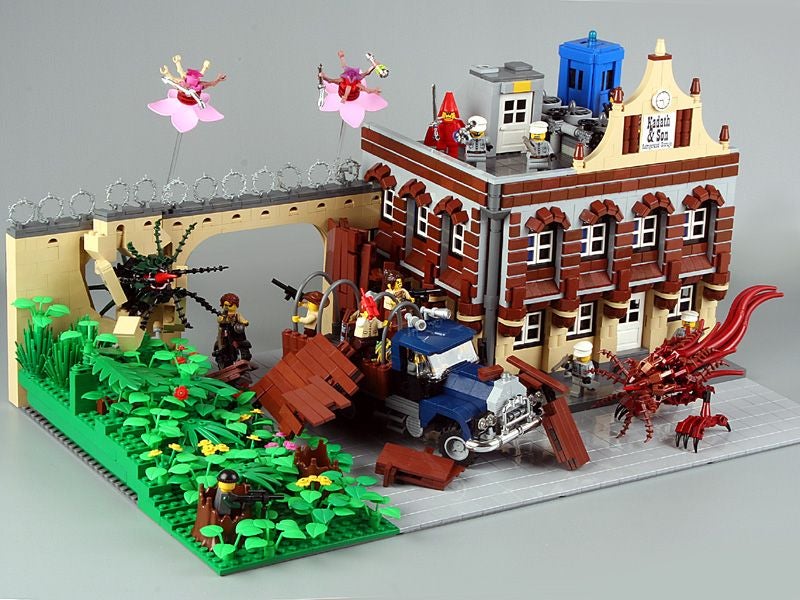
As a proponent of legos as superb figures for tabletop gaming, I felt the need to share this with what few readers I theoretically have.
Monday, December 7, 2015
Motor(?) Monday: Space Vehicle Design
Nothing new happening with car shopping, drove a ford escape with a bunch of nice stuff about it that I'd probably have put money down on already if it had limited slip and a button to lock it into 4wd if desired.
ONWARDS to my actual topic: SPAAACEships.
Specifically, trying to design approximately dieselpunk spaceships for the alt history game setting I'm working on with the Moon Marines. Trying to make them mostly realistic with the caveat of the setting featuring a couple elements of superscience to allow for spacefaring shenanigans without recordkeeping to manage keeping tabs on reaction mass and such. TL;DR of the setting is it's way later in time, humanity has been pulled into the future during the Manhattan Project and given some alien tech to reverse engineer. They fix/break it, and start exploring. I'm considering giving the ships a modernized WWII kind of vibe, and having a lot of spaceships able to land on the water due to alien not-rockets permitting heavily armed and armored spaceboats. Humanity's great wealth of knowledge related to loading, crewing, and fighting aboard ships was taken advantage of, along with moderate aircraft experience and marginal space knowledge.
 One of my first inspirations is the Surcouf Submarine Cruiser. It's usable as a ship, with deck space up top, and nicely sized gun turrets (enormous for a submarine). It's streamlined and has the style I want. Not the most airworthy, but that's what lifting body style tweaks and unreasonably powerful space engines, and maybe a set of stub wings that fold flat for some extra lift and to help with climbing out of atmosphere when you can't be bothered to boost into orbit on engine power alone.
 Obviously it's meant to fly, at least during the transition between spaceship and regular ship. Getting around like a very well-sealed seaplane is probably faster and more effective in a vehicle powered by reactor fueled not-rockets than forcing it through/over the water. A broader body would probably be more likely, to increase space and maintain a nice airworthy wedge design.
There's always the old standby of sphere ships, which to maintain the style of the setting would probably be vaguely cube shaped and rounded in something of the nature of the M4 sherman. Not great for in atmosphere use, beyond takeoffs and landings.
But now, I come to my real problem
Gravity. I'm not using artificial gravity generation, but would like at least a small amount of gravity to allow some semblance of normal life (ability to cook in a pan, sit at a table for cards that don't need magnetism or somesuch, and so on). All gravity has to come from spin gravity, either for the whole ship or more likely having a section of the ship feature a separate centrifuge portion containing the habitation modules, or from using slight superscience to maintain felt acceleration gravity. Given that the ship is meant to be usable as a ship on the surface, there are some issues with both of these methods.
Gravity, on a normal aircraft or oceangoing ship, points downwards. produced via spingrav, portions of the ship will be upside down while in atmosphere if using an included centrifuge (which may be split into a habitation block and a region not used while in gravity or otherwise still usable while upside down, or trading some space for mechanisms to allow rooms to rotate). Simply spinning the ship about an axis is difficult due a probable lack of a nice round axis had by most ships able to land planetside. Still, if a ship has a center of gravity close enough to what would be the top deck while planetside, it can rotate such that the lower deck has spin gravity. It'll look weird as heck, but if it's weird but it works it's not weird. A tumbling pigeon design does not work with the requirements of interstellar travel within the setting.

Produced via acceleration, effective gravity will point towards the back of the ship. It's possible to arrange the whole ship for acceleration gravity, and have it point upwards while it's landed like a tail-landing craft, but that comes with its own set of challenges. Suddenly the entire ship is a spacefaring skyscraper that must be navigated by steps, ladders, manlifts, elevators, and fireman's poles. It's also weird during actual flight if you use aerodynamics rather than pure engine power. Alternatively, the engines could force the ship sideways through space, such that down is always down. This results in a rather large frontal area to heavily armor, but plays quite nicely with keeping an otherwise standard deckplan, allowing systems to be navigated via hallway and corridors with a few levels.

The other options are that the ship is just in 0G or microgravity all places except where it's absolutely necessary for something resembling normal function, or that I opt to include a crude gravity generator to the setting. Micrograv is weird but manageable, and through tech and proper design pretty easily handled. Artificial gravity requires just a little bit more handwaving than allowing small amounts of constant speed acceleration gravity thanks to warp drive effects and is easily compatible with a ship designed to also function in and out of gravity.
EDIT TO ADD:
After sleeping on it, bouncing ideas, and doing some math, it seems that flying the ship in a helical flight path can generate gravity pretty darn readily. If it's stupid but it works, it isn't stupid. It requires constant thrust, but given that the ships are reactor powered and reactionlessly driven, it's the simplest solution to the 0G problem.
ONWARDS to my actual topic: SPAAACEships.
Specifically, trying to design approximately dieselpunk spaceships for the alt history game setting I'm working on with the Moon Marines. Trying to make them mostly realistic with the caveat of the setting featuring a couple elements of superscience to allow for spacefaring shenanigans without recordkeeping to manage keeping tabs on reaction mass and such. TL;DR of the setting is it's way later in time, humanity has been pulled into the future during the Manhattan Project and given some alien tech to reverse engineer. They fix/break it, and start exploring. I'm considering giving the ships a modernized WWII kind of vibe, and having a lot of spaceships able to land on the water due to alien not-rockets permitting heavily armed and armored spaceboats. Humanity's great wealth of knowledge related to loading, crewing, and fighting aboard ships was taken advantage of, along with moderate aircraft experience and marginal space knowledge.
 |
| A flying boat lifting body spaceship, you say.... |
There's always the old standby of sphere ships, which to maintain the style of the setting would probably be vaguely cube shaped and rounded in something of the nature of the M4 sherman. Not great for in atmosphere use, beyond takeoffs and landings.
But now, I come to my real problem
Gravity. I'm not using artificial gravity generation, but would like at least a small amount of gravity to allow some semblance of normal life (ability to cook in a pan, sit at a table for cards that don't need magnetism or somesuch, and so on). All gravity has to come from spin gravity, either for the whole ship or more likely having a section of the ship feature a separate centrifuge portion containing the habitation modules, or from using slight superscience to maintain felt acceleration gravity. Given that the ship is meant to be usable as a ship on the surface, there are some issues with both of these methods.
Gravity, on a normal aircraft or oceangoing ship, points downwards. produced via spingrav, portions of the ship will be upside down while in atmosphere if using an included centrifuge (which may be split into a habitation block and a region not used while in gravity or otherwise still usable while upside down, or trading some space for mechanisms to allow rooms to rotate). Simply spinning the ship about an axis is difficult due a probable lack of a nice round axis had by most ships able to land planetside. Still, if a ship has a center of gravity close enough to what would be the top deck while planetside, it can rotate such that the lower deck has spin gravity. It'll look weird as heck, but if it's weird but it works it's not weird. A tumbling pigeon design does not work with the requirements of interstellar travel within the setting.
Produced via acceleration, effective gravity will point towards the back of the ship. It's possible to arrange the whole ship for acceleration gravity, and have it point upwards while it's landed like a tail-landing craft, but that comes with its own set of challenges. Suddenly the entire ship is a spacefaring skyscraper that must be navigated by steps, ladders, manlifts, elevators, and fireman's poles. It's also weird during actual flight if you use aerodynamics rather than pure engine power. Alternatively, the engines could force the ship sideways through space, such that down is always down. This results in a rather large frontal area to heavily armor, but plays quite nicely with keeping an otherwise standard deckplan, allowing systems to be navigated via hallway and corridors with a few levels.
The other options are that the ship is just in 0G or microgravity all places except where it's absolutely necessary for something resembling normal function, or that I opt to include a crude gravity generator to the setting. Micrograv is weird but manageable, and through tech and proper design pretty easily handled. Artificial gravity requires just a little bit more handwaving than allowing small amounts of constant speed acceleration gravity thanks to warp drive effects and is easily compatible with a ship designed to also function in and out of gravity.
EDIT TO ADD:
After sleeping on it, bouncing ideas, and doing some math, it seems that flying the ship in a helical flight path can generate gravity pretty darn readily. If it's stupid but it works, it isn't stupid. It requires constant thrust, but given that the ships are reactor powered and reactionlessly driven, it's the simplest solution to the 0G problem.
Saturday, September 12, 2015
Murderhoboing along
Things Players Do that Real People Never Would
I've run into other players that behaved in a manner that made me curious how they functioned in the real world, they were so poorly able to function in a simulated/imaginary one.
I've run into other players that behaved in a manner that made me curious how they functioned in the real world, they were so poorly able to function in a simulated/imaginary one.
Saturday, June 13, 2015
GURPS CheatSheet: 4e Basic Set in 5 pages or less
In my quest to make GURPS a bit more playable for people who aren't crazy and read its copious amounts of rules, and to supplement my own GM screen, I went through and collected most of the major rules of GURPS into a handy little compendium. By getting just the rules, it collects the actual stuff needed to play into about 5 pages (skipping all the character generation stuff and rules attached to that, with the expectation that a player will make their own reference sheet for things that effect them).
https://www.dropbox.com/s/eb1gp2cxe0jjv9i/GURPS%20cheatsheet.odt?dl=0
Still tweaking, formatting, and adding to it, but there's the sheet as it presently is
Page 1 is basics of play: odds of 3d6 based success, the different types of tests, and when to roll.
Page 2 is combat basics, the turn order, and so on
Page 3 is rules for injury and recovery
Page 4 and 5 are further special situations, including rules for shooting things in cover, size/range/speed tables, rate of fire bonuses, and hit locations.
https://www.dropbox.com/s/eb1gp2cxe0jjv9i/GURPS%20cheatsheet.odt?dl=0
Still tweaking, formatting, and adding to it, but there's the sheet as it presently is
Page 1 is basics of play: odds of 3d6 based success, the different types of tests, and when to roll.
Page 2 is combat basics, the turn order, and so on
Page 3 is rules for injury and recovery
Page 4 and 5 are further special situations, including rules for shooting things in cover, size/range/speed tables, rate of fire bonuses, and hit locations.
Tuesday, March 24, 2015
GURPS: Perks and skill musings
Some more musings on GURPS and perks and such that are missing, and pondering on the workings of melee combat damage.
PERK: Walk the Trigger. Normally semi automatic weapons cannot be used for Spraying Fire, even if they meet the 5+ RoF through things like Fast Firing. Walk the Trigger means the shooter has practiced maintaining a fast, steady cadence of fire separately from the point of aim, allowing the gun to be used in a manner identical to that of a full auto.
PERK: Running Ready. You've practiced controlling your body. So long as you do not exceed your Long Distance move speed and the objects to be interacted with are not linked to bodyparts used for motion, you may perform a ready maneuver while moving. EXAMPLE, drawing a weapon or magazine from a quality belt holster while running is fine, doing the same from holsters lashed to your thighs is not.
PERK: Recoil compensation. Through sheer mass or special stances, you've learned to keep control of your weapon. When using the higher fire rates of Fast Firing with a semiauto gun, reduce the added recoil by 1. Cannot reduce the recoil below base value, only serves to allow more accurate high RoF shooting.
High Strength Melee Weapons
GURPS 4e is pretty clearly balanced for people within a few points of "average" ST of 10. This works well enough, unless you have a big bruiser of a character. Where a difference between a knife and a broadsword's average damage is quite significant at ST 10, it becomes almost negligible at something like ST 17. The rules for melee damage scale based on ST fairly well, and include a measure of the difference in power into the progression, but a Swing+1 sword remains Swing+1, whether it's being driven by a 1d-1 swing or a 3d swing. I can't think of anything better to replace it with that doesn't adding probably needless levels of complexity, but it still seems to need a bit of pondering.
High Skill Melee Weapon Damage
Unarmed combat in GURPS gains bonuses as your skill increases, which is good because much of combat is all in the technique. The problem I see is that to do this with weapon skills requires the Weapon Master advantage. Weapon Master damage bonuses follow the progression of Boxing and Karate, with DX+1 skill giving +1 damage/die, and DX+2 skill giving +2 damage/die. I'm inclined to house rule that high skill with a melee weapon follows the bonus progression of Brawling, with +1 dmg/die at DX+2 skill. Not a lot, but enough to represent the boost gained due to proficiency.
PERK: Walk the Trigger. Normally semi automatic weapons cannot be used for Spraying Fire, even if they meet the 5+ RoF through things like Fast Firing. Walk the Trigger means the shooter has practiced maintaining a fast, steady cadence of fire separately from the point of aim, allowing the gun to be used in a manner identical to that of a full auto.
PERK: Running Ready. You've practiced controlling your body. So long as you do not exceed your Long Distance move speed and the objects to be interacted with are not linked to bodyparts used for motion, you may perform a ready maneuver while moving. EXAMPLE, drawing a weapon or magazine from a quality belt holster while running is fine, doing the same from holsters lashed to your thighs is not.
PERK: Recoil compensation. Through sheer mass or special stances, you've learned to keep control of your weapon. When using the higher fire rates of Fast Firing with a semiauto gun, reduce the added recoil by 1. Cannot reduce the recoil below base value, only serves to allow more accurate high RoF shooting.
High Strength Melee Weapons
GURPS 4e is pretty clearly balanced for people within a few points of "average" ST of 10. This works well enough, unless you have a big bruiser of a character. Where a difference between a knife and a broadsword's average damage is quite significant at ST 10, it becomes almost negligible at something like ST 17. The rules for melee damage scale based on ST fairly well, and include a measure of the difference in power into the progression, but a Swing+1 sword remains Swing+1, whether it's being driven by a 1d-1 swing or a 3d swing. I can't think of anything better to replace it with that doesn't adding probably needless levels of complexity, but it still seems to need a bit of pondering.
High Skill Melee Weapon Damage
Unarmed combat in GURPS gains bonuses as your skill increases, which is good because much of combat is all in the technique. The problem I see is that to do this with weapon skills requires the Weapon Master advantage. Weapon Master damage bonuses follow the progression of Boxing and Karate, with DX+1 skill giving +1 damage/die, and DX+2 skill giving +2 damage/die. I'm inclined to house rule that high skill with a melee weapon follows the bonus progression of Brawling, with +1 dmg/die at DX+2 skill. Not a lot, but enough to represent the boost gained due to proficiency.
Sunday, February 22, 2015
Space Combat: 2d demonstration
http://luftrausers.com/
Despite Luftrausers referring to your vehicle as an airplane, at no point in time does it fly by means of aerodynamic lift. It's all boosters, all the time. With the Zero Gravity engine, it even drifts along in whichever way it was moving when you stop boosting.
In short, it controls much like a maneuvering space combat vehicle would: A lot of little thrusters to turn, with the main booster performing all the work. This can be hard to visualize when it's described to people, and yet here's an action packed, fun little game that approximates it quite wonderfully.
Despite Luftrausers referring to your vehicle as an airplane, at no point in time does it fly by means of aerodynamic lift. It's all boosters, all the time. With the Zero Gravity engine, it even drifts along in whichever way it was moving when you stop boosting.
In short, it controls much like a maneuvering space combat vehicle would: A lot of little thrusters to turn, with the main booster performing all the work. This can be hard to visualize when it's described to people, and yet here's an action packed, fun little game that approximates it quite wonderfully.
Subscribe to:
Posts (Atom)