War for territory is one of the oldest tropes of the space genre. But getting things through space is a challenge, particularly people; people need not only tonnage and space, but life support. How do you conveniently get a whole army, which needs a lot of mass for equipment and the troops to use it themselves.
Hang on, isn't spacewar supposed to be so advanced, that troops are no longer required? Deathrays from space make invasion unnecessary, point defenses make it impossible, and nobody will even bother with anything but spaceships, right?
Wrong. I mean I can't say with certainty until it happens, but every new weapon and invention is the end of infantry and gunfights and everything else forever, for sure THIS time! Just like every new weapon is so devastating it will end all wars forever, although after two world wars it seems like pundits have learned better than to say that now.
Troops will be necessary, any time goals below "extermination" are desired; a population brought into line, a strategic asset taken, etc.
So that leaves us with a dilemma; Even with reactionless drives and FTL transit to avoid century long trips, shipping enough to fight a war across (inter)stellar distances is a pain. Infantry, whether a Galactic Patrol's marine compliment or a purpose built troop transport, will be needed to get things done.
Option one: Big Ships
You can fit a fair few troops in a ship. The point at which you can wage spacewar, you can manage ships of at least capital sizes, from frigates to cruisers. They probably can't land on the surface themselves, but they'll have landers and lighters and perhaps drop pods. Technology will allow the ship to have vast food stores for the voyage and/or food production aboard, with less crew needed for the ship and a larger troop compliment available.
Option two: Stasis
Hypersleep. Suspended Animation. It goes by many names, but the idea of cramming troops into cold storage for the duration of interstellar voyage is an appealing one. Slow them down or stop them and they need little to no food or water, just power if their storage system requires it to maintain function (which is likely, but some wonder materials allow such shenanigans to be harnessed naturally). If you aren't likely to need everyone in an unplanned-for hurry, you can take a whole army and pack them up, perhaps defrosting them in shifts depending on the nature of storage and its ease of sleep/wakeup such that they don't disconnect from the world for weeks or months at a time, keeping enough awake to manage tasks and hold the fort until the rest can be roused to function.
Option three: Droids
What if you didn't need human troops? This has long been considered the future of warfare, with just as many detractors. A robot army, AI programmed to be as empathetic or unfeeling as desired, with none of those human failings and urges to distract from the mission. When they're broken, you can just repair them, or disassemble them as parts to keep the others fighting, and even produce more as required.
Throughout media, usually one or more of these winds up in play. Droids usually belong to the bad guys, unthinking, unfeeling, and merciless in their enforcement of the cruel edicts of their conquering masters. If droids are in play, the good guys will have good honest armies, awake and plucky. Stasis is usually the realm of one of two major tropes; the sealed badass in a can, or realistic space transit where there's no benefit to having huge masses of troops awake and draining resources, bored in the infinite vastness of space.
I've said all I really have to say on the first two options, but the third... the third bears some elaboration, because it has such potential for how underutilized it is. It was the planned topic of this discussion, until I deemed it worthwhile to provide some lead in and background. Look for that on Interstellar Warfare Wednesday.
Showing posts with label The Moon Marines. Show all posts
Showing posts with label The Moon Marines. Show all posts
Friday, March 1, 2019

Wednesday, May 11, 2016
Interstellar Warfare Wednesday: Mechs?
A new one of these, on a topic I've given a great deal of thought to recently; mechs.
Traditionally, the mech is viewed as a rule-of-cool technological dead end. Everyone loves giant robots, but a box of armor with a turret on it will be far more stable and heavily armored. Boring but practical, the mech just can't compete with ye olde tanks. Or can it?
To preface, we need to look at what role a mech, walker, etc would serve to fill. There are, far as I can tell, two main roles to fill. The first is a direct competitor to the tank, except not. The second is a lightweight armored gun platform intended to support infantry in the manner of an IFV, without the internal space.
Next, we need a few assumptions about how the thing is built. Legs are pretty complicated, but can be broken down to a few main joints. Hydraulics are finicky and easily damaged, but modern or near future high end servos are compact and powerful. Assuming heavily armored joints, the main meat of the legs can be relatively lightly armored so long as it's sturdy enough to continue functioning with a few holes in it. Because anything will need to keep up with tanks/trucks/etc, these legs will need to have some manner of wheel or track mechanism. Finally, legs are still relatively easily damaged, so they need to be easily swapped when damaged.
Looking more at the first style, the spider tank; Under most use, it's just a tank. Legs folded and tracks engaged, it presents a slightly smaller profile than a normal tank, with the option to poke its head up over terrain to more easily fire from a hull-down position, shift to maintain balance during maneuvering, and other such things. Pressed with an obstacle that tracks can't climb, it may be able walk up or down them, and throwing a track can be worked around by shifting weight away from that leg. Ultimately, the spidertank is just tank+, likely optimized for minimal weight for mobility when hitching a ride. If there are other more traditional tanks (such as those that follow the pattern of the Israeli Merkava (MBT+IFV)), it'd share a turret with them.
The second style is the lighter weight mech, weighing a few tons at most. Any smaller and it'd be a battlesuit, and indeed probably is close in size to a heavy battlesuit, though far more broad. The primary aim is to get a weapons platform that can be airlifted or dropped with troops, able to withstand enough weaponry to play bullet sponge while delivering firepower akin to an IFV. Compact size and weight means they can fit places a heavy armored vehicle couldn't. Still, they'd similarly need tracks/wheels/etc to keep pace with trucks and other armor. Could be built in biped or quadruped formfactors; quad is more stable, but necessarily heavier. Whatever form factor it took, most of the time it'd still roll rather than walk if it didn't need the added mobility.
Having legs available makes further possibilities, well, possible. Adding them as landing gear to dropships and similar allows for easier dropoffs of troops in areas that normally would require incredibly skilled, dangerous hovering, or improve the ability to grab and hold payloads steady. Anything with legs can jack itself off the ground for minor repairs.
I've also been trying to figure out how to model these in GURPS, but that's another post.
Traditionally, the mech is viewed as a rule-of-cool technological dead end. Everyone loves giant robots, but a box of armor with a turret on it will be far more stable and heavily armored. Boring but practical, the mech just can't compete with ye olde tanks. Or can it?
To preface, we need to look at what role a mech, walker, etc would serve to fill. There are, far as I can tell, two main roles to fill. The first is a direct competitor to the tank, except not. The second is a lightweight armored gun platform intended to support infantry in the manner of an IFV, without the internal space.
Next, we need a few assumptions about how the thing is built. Legs are pretty complicated, but can be broken down to a few main joints. Hydraulics are finicky and easily damaged, but modern or near future high end servos are compact and powerful. Assuming heavily armored joints, the main meat of the legs can be relatively lightly armored so long as it's sturdy enough to continue functioning with a few holes in it. Because anything will need to keep up with tanks/trucks/etc, these legs will need to have some manner of wheel or track mechanism. Finally, legs are still relatively easily damaged, so they need to be easily swapped when damaged.
Looking more at the first style, the spider tank; Under most use, it's just a tank. Legs folded and tracks engaged, it presents a slightly smaller profile than a normal tank, with the option to poke its head up over terrain to more easily fire from a hull-down position, shift to maintain balance during maneuvering, and other such things. Pressed with an obstacle that tracks can't climb, it may be able walk up or down them, and throwing a track can be worked around by shifting weight away from that leg. Ultimately, the spidertank is just tank+, likely optimized for minimal weight for mobility when hitching a ride. If there are other more traditional tanks (such as those that follow the pattern of the Israeli Merkava (MBT+IFV)), it'd share a turret with them.
The second style is the lighter weight mech, weighing a few tons at most. Any smaller and it'd be a battlesuit, and indeed probably is close in size to a heavy battlesuit, though far more broad. The primary aim is to get a weapons platform that can be airlifted or dropped with troops, able to withstand enough weaponry to play bullet sponge while delivering firepower akin to an IFV. Compact size and weight means they can fit places a heavy armored vehicle couldn't. Still, they'd similarly need tracks/wheels/etc to keep pace with trucks and other armor. Could be built in biped or quadruped formfactors; quad is more stable, but necessarily heavier. Whatever form factor it took, most of the time it'd still roll rather than walk if it didn't need the added mobility.
Having legs available makes further possibilities, well, possible. Adding them as landing gear to dropships and similar allows for easier dropoffs of troops in areas that normally would require incredibly skilled, dangerous hovering, or improve the ability to grab and hold payloads steady. Anything with legs can jack itself off the ground for minor repairs.
I've also been trying to figure out how to model these in GURPS, but that's another post.
Monday, December 7, 2015
Motor(?) Monday: Space Vehicle Design
Nothing new happening with car shopping, drove a ford escape with a bunch of nice stuff about it that I'd probably have put money down on already if it had limited slip and a button to lock it into 4wd if desired.
ONWARDS to my actual topic: SPAAACEships.
Specifically, trying to design approximately dieselpunk spaceships for the alt history game setting I'm working on with the Moon Marines. Trying to make them mostly realistic with the caveat of the setting featuring a couple elements of superscience to allow for spacefaring shenanigans without recordkeeping to manage keeping tabs on reaction mass and such. TL;DR of the setting is it's way later in time, humanity has been pulled into the future during the Manhattan Project and given some alien tech to reverse engineer. They fix/break it, and start exploring. I'm considering giving the ships a modernized WWII kind of vibe, and having a lot of spaceships able to land on the water due to alien not-rockets permitting heavily armed and armored spaceboats. Humanity's great wealth of knowledge related to loading, crewing, and fighting aboard ships was taken advantage of, along with moderate aircraft experience and marginal space knowledge.
 One of my first inspirations is the Surcouf Submarine Cruiser. It's usable as a ship, with deck space up top, and nicely sized gun turrets (enormous for a submarine). It's streamlined and has the style I want. Not the most airworthy, but that's what lifting body style tweaks and unreasonably powerful space engines, and maybe a set of stub wings that fold flat for some extra lift and to help with climbing out of atmosphere when you can't be bothered to boost into orbit on engine power alone.
 Obviously it's meant to fly, at least during the transition between spaceship and regular ship. Getting around like a very well-sealed seaplane is probably faster and more effective in a vehicle powered by reactor fueled not-rockets than forcing it through/over the water. A broader body would probably be more likely, to increase space and maintain a nice airworthy wedge design.
There's always the old standby of sphere ships, which to maintain the style of the setting would probably be vaguely cube shaped and rounded in something of the nature of the M4 sherman. Not great for in atmosphere use, beyond takeoffs and landings.
But now, I come to my real problem
Gravity. I'm not using artificial gravity generation, but would like at least a small amount of gravity to allow some semblance of normal life (ability to cook in a pan, sit at a table for cards that don't need magnetism or somesuch, and so on). All gravity has to come from spin gravity, either for the whole ship or more likely having a section of the ship feature a separate centrifuge portion containing the habitation modules, or from using slight superscience to maintain felt acceleration gravity. Given that the ship is meant to be usable as a ship on the surface, there are some issues with both of these methods.
Gravity, on a normal aircraft or oceangoing ship, points downwards. produced via spingrav, portions of the ship will be upside down while in atmosphere if using an included centrifuge (which may be split into a habitation block and a region not used while in gravity or otherwise still usable while upside down, or trading some space for mechanisms to allow rooms to rotate). Simply spinning the ship about an axis is difficult due a probable lack of a nice round axis had by most ships able to land planetside. Still, if a ship has a center of gravity close enough to what would be the top deck while planetside, it can rotate such that the lower deck has spin gravity. It'll look weird as heck, but if it's weird but it works it's not weird. A tumbling pigeon design does not work with the requirements of interstellar travel within the setting.

Produced via acceleration, effective gravity will point towards the back of the ship. It's possible to arrange the whole ship for acceleration gravity, and have it point upwards while it's landed like a tail-landing craft, but that comes with its own set of challenges. Suddenly the entire ship is a spacefaring skyscraper that must be navigated by steps, ladders, manlifts, elevators, and fireman's poles. It's also weird during actual flight if you use aerodynamics rather than pure engine power. Alternatively, the engines could force the ship sideways through space, such that down is always down. This results in a rather large frontal area to heavily armor, but plays quite nicely with keeping an otherwise standard deckplan, allowing systems to be navigated via hallway and corridors with a few levels.

The other options are that the ship is just in 0G or microgravity all places except where it's absolutely necessary for something resembling normal function, or that I opt to include a crude gravity generator to the setting. Micrograv is weird but manageable, and through tech and proper design pretty easily handled. Artificial gravity requires just a little bit more handwaving than allowing small amounts of constant speed acceleration gravity thanks to warp drive effects and is easily compatible with a ship designed to also function in and out of gravity.
EDIT TO ADD:
After sleeping on it, bouncing ideas, and doing some math, it seems that flying the ship in a helical flight path can generate gravity pretty darn readily. If it's stupid but it works, it isn't stupid. It requires constant thrust, but given that the ships are reactor powered and reactionlessly driven, it's the simplest solution to the 0G problem.
ONWARDS to my actual topic: SPAAACEships.
Specifically, trying to design approximately dieselpunk spaceships for the alt history game setting I'm working on with the Moon Marines. Trying to make them mostly realistic with the caveat of the setting featuring a couple elements of superscience to allow for spacefaring shenanigans without recordkeeping to manage keeping tabs on reaction mass and such. TL;DR of the setting is it's way later in time, humanity has been pulled into the future during the Manhattan Project and given some alien tech to reverse engineer. They fix/break it, and start exploring. I'm considering giving the ships a modernized WWII kind of vibe, and having a lot of spaceships able to land on the water due to alien not-rockets permitting heavily armed and armored spaceboats. Humanity's great wealth of knowledge related to loading, crewing, and fighting aboard ships was taken advantage of, along with moderate aircraft experience and marginal space knowledge.
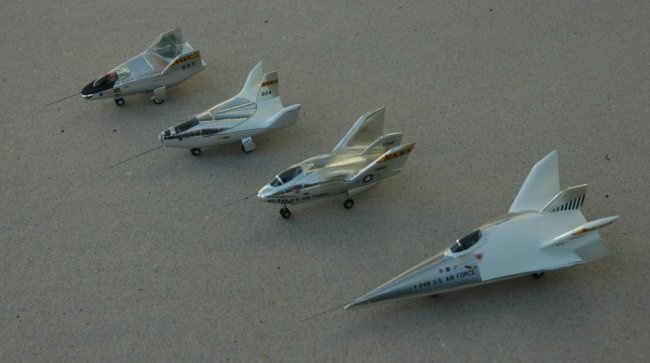
 |
| A flying boat lifting body spaceship, you say.... |
There's always the old standby of sphere ships, which to maintain the style of the setting would probably be vaguely cube shaped and rounded in something of the nature of the M4 sherman. Not great for in atmosphere use, beyond takeoffs and landings.
But now, I come to my real problem
Gravity. I'm not using artificial gravity generation, but would like at least a small amount of gravity to allow some semblance of normal life (ability to cook in a pan, sit at a table for cards that don't need magnetism or somesuch, and so on). All gravity has to come from spin gravity, either for the whole ship or more likely having a section of the ship feature a separate centrifuge portion containing the habitation modules, or from using slight superscience to maintain felt acceleration gravity. Given that the ship is meant to be usable as a ship on the surface, there are some issues with both of these methods.
Gravity, on a normal aircraft or oceangoing ship, points downwards. produced via spingrav, portions of the ship will be upside down while in atmosphere if using an included centrifuge (which may be split into a habitation block and a region not used while in gravity or otherwise still usable while upside down, or trading some space for mechanisms to allow rooms to rotate). Simply spinning the ship about an axis is difficult due a probable lack of a nice round axis had by most ships able to land planetside. Still, if a ship has a center of gravity close enough to what would be the top deck while planetside, it can rotate such that the lower deck has spin gravity. It'll look weird as heck, but if it's weird but it works it's not weird. A tumbling pigeon design does not work with the requirements of interstellar travel within the setting.
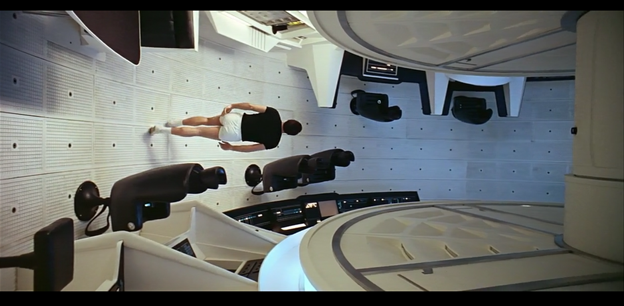
Produced via acceleration, effective gravity will point towards the back of the ship. It's possible to arrange the whole ship for acceleration gravity, and have it point upwards while it's landed like a tail-landing craft, but that comes with its own set of challenges. Suddenly the entire ship is a spacefaring skyscraper that must be navigated by steps, ladders, manlifts, elevators, and fireman's poles. It's also weird during actual flight if you use aerodynamics rather than pure engine power. Alternatively, the engines could force the ship sideways through space, such that down is always down. This results in a rather large frontal area to heavily armor, but plays quite nicely with keeping an otherwise standard deckplan, allowing systems to be navigated via hallway and corridors with a few levels.
The other options are that the ship is just in 0G or microgravity all places except where it's absolutely necessary for something resembling normal function, or that I opt to include a crude gravity generator to the setting. Micrograv is weird but manageable, and through tech and proper design pretty easily handled. Artificial gravity requires just a little bit more handwaving than allowing small amounts of constant speed acceleration gravity thanks to warp drive effects and is easily compatible with a ship designed to also function in and out of gravity.
EDIT TO ADD:
After sleeping on it, bouncing ideas, and doing some math, it seems that flying the ship in a helical flight path can generate gravity pretty darn readily. If it's stupid but it works, it isn't stupid. It requires constant thrust, but given that the ships are reactor powered and reactionlessly driven, it's the simplest solution to the 0G problem.
Saturday, December 5, 2015
Sci-Fi Saturday: The World of the Moon Marines
We were the precursors. All our calculations, all our research from our pale blue dot, a spec of dust floating in a sunbeam, it all agreed. When we raised our eyes to the heavens in search of answers and received only silence, it was because we were first. So many billions of years seemed like a long time, but it was a mere fraction of the time the universe would persist.
So we reached for the stars. We spread our species throughout the system, ever hoping to hear from another race. We never received an answer, so we did what the precursors always do; We seeded the galaxy with life. We loaded our ordinance, developed for use against ourselves and honed to perfect over many lifetimes, with the basics of life. The hardiest microbes, able to survive anywhere. Cluster bombs of enormous size, atop rockets of unparalleled enormity. Were something to happen to us, our planets legacy as the cradle of life would not end. We planned to follow, in great colony ships to be built.
We never made it that far.
It's hard to say what cosmic calamity befell the Sol system, but we were no more. The cradle of life was extinguished.
Many years have passed since, and life has flourished throughout the galaxy. Some of it may even harken back to those converted weapons, launched untold millenia ago. Where one sapient species finds another, they are uplifted to the galactic community, and peace largely prevails.
But peace is fleeting. The eldest of races, the second precursors, saw the chaos looming, a chaos for which the galaxy was unprepared. Artifacts hinted at another civilization, ancient beyond measure. A civilization that had raised itself to the heavens alone, and vanished. The artifacts were dated, their trajectories compiled, and their homeworld found, a dead system with an aging star in a galactic backwater.
Humanity would be reborn, brought back from the ravages of time in hopes that their wisdom will save the galaxy. Plans were set in motion, and the Sol System was imploded, replaced with a copy from eons past, when humanity still flourished. The estimate of time was rough, and we had not yet reached to the stars, but there was time for us to develop before we were needed.
With the detonation of the Manhattan project, some members questioned our supposed precursor wisdom, but others had suspicions we were what the galaxy needed confirmed. Without explanation we were given a few pieces of technology we couldn't understand yet, and left to the tender mercies of our garden world with the secret hopes of the galaxy.
Even proof of extraterrestrial life, revealed to a few key scientists, could not sway the course of history by much. The alien devices were studied and set aside as too advanced. With every advancement the artifacts were dusted off and re-examined, as the space race was pursued with enhanced purpose. Where there was the possibility of life beyond Earth on our first foray beyond the planet was addressed, now there was proof. The Apollo program was largely unchanged for most of its development, but the knowledge that there were aliens who had seen fit to visit us would change the course of history.
By the new 1970s, the alien technology began to be understood. By the end of the 70s, we had begun to understand the technology, and were able to begin to examine it in earnest. By the end of the Cold War, we had begun to be able to copy the technology; we knew how it worked, even if we couldn't explain why. Reactionless rockets, quantum communications, and a device that seemed to raise the universal speed limit of Light Speed. Where our space program faltered, the new humanity used its boons and added purpose to charge ahead. The moon was colonized, and our military might was extended beyond the Earth. Spurred onwards by reverse engineering, ease of space-borne experiments, interplanetary resources, and the secret knowledge that there was other life to compete with, science advanced swiftly.
As our understanding grew, we began to recognize the changes, that something with the universe had changed around the Manhattan Project and a great deal of time had passed. With this information found, and the alien technology understood, the greatest news was finally broken.
We had met aliens, and were given technology. We know nothing of who, or why; Humanity had been brought forward in time, having once been at the front of the curve. We still had yet to make contact with our mysterious benefactors, but we were ready. Whatever tests lay ahead, we would not be found wanting. Whether it was hoped that we would be worthy adversaries or galactic heroes, we meant to be prepared.
At the turn of the century, as we fired up our first Stardrive and set course for the nearest system, we affirmed our purpose. We came in peace, for all mankind. We walked softly, but carried a big stick. We would get further with a kind word and a gun than a kind word alone.
First contact was made in 2010. The present year is 2015.
We were not the wise ancients the second precursors had hoped for, but we were what the galaxy needed.
So we reached for the stars. We spread our species throughout the system, ever hoping to hear from another race. We never received an answer, so we did what the precursors always do; We seeded the galaxy with life. We loaded our ordinance, developed for use against ourselves and honed to perfect over many lifetimes, with the basics of life. The hardiest microbes, able to survive anywhere. Cluster bombs of enormous size, atop rockets of unparalleled enormity. Were something to happen to us, our planets legacy as the cradle of life would not end. We planned to follow, in great colony ships to be built.
We never made it that far.
It's hard to say what cosmic calamity befell the Sol system, but we were no more. The cradle of life was extinguished.
Many years have passed since, and life has flourished throughout the galaxy. Some of it may even harken back to those converted weapons, launched untold millenia ago. Where one sapient species finds another, they are uplifted to the galactic community, and peace largely prevails.
But peace is fleeting. The eldest of races, the second precursors, saw the chaos looming, a chaos for which the galaxy was unprepared. Artifacts hinted at another civilization, ancient beyond measure. A civilization that had raised itself to the heavens alone, and vanished. The artifacts were dated, their trajectories compiled, and their homeworld found, a dead system with an aging star in a galactic backwater.
Humanity would be reborn, brought back from the ravages of time in hopes that their wisdom will save the galaxy. Plans were set in motion, and the Sol System was imploded, replaced with a copy from eons past, when humanity still flourished. The estimate of time was rough, and we had not yet reached to the stars, but there was time for us to develop before we were needed.
With the detonation of the Manhattan project, some members questioned our supposed precursor wisdom, but others had suspicions we were what the galaxy needed confirmed. Without explanation we were given a few pieces of technology we couldn't understand yet, and left to the tender mercies of our garden world with the secret hopes of the galaxy.
Even proof of extraterrestrial life, revealed to a few key scientists, could not sway the course of history by much. The alien devices were studied and set aside as too advanced. With every advancement the artifacts were dusted off and re-examined, as the space race was pursued with enhanced purpose. Where there was the possibility of life beyond Earth on our first foray beyond the planet was addressed, now there was proof. The Apollo program was largely unchanged for most of its development, but the knowledge that there were aliens who had seen fit to visit us would change the course of history.
By the new 1970s, the alien technology began to be understood. By the end of the 70s, we had begun to understand the technology, and were able to begin to examine it in earnest. By the end of the Cold War, we had begun to be able to copy the technology; we knew how it worked, even if we couldn't explain why. Reactionless rockets, quantum communications, and a device that seemed to raise the universal speed limit of Light Speed. Where our space program faltered, the new humanity used its boons and added purpose to charge ahead. The moon was colonized, and our military might was extended beyond the Earth. Spurred onwards by reverse engineering, ease of space-borne experiments, interplanetary resources, and the secret knowledge that there was other life to compete with, science advanced swiftly.
As our understanding grew, we began to recognize the changes, that something with the universe had changed around the Manhattan Project and a great deal of time had passed. With this information found, and the alien technology understood, the greatest news was finally broken.
We had met aliens, and were given technology. We know nothing of who, or why; Humanity had been brought forward in time, having once been at the front of the curve. We still had yet to make contact with our mysterious benefactors, but we were ready. Whatever tests lay ahead, we would not be found wanting. Whether it was hoped that we would be worthy adversaries or galactic heroes, we meant to be prepared.
At the turn of the century, as we fired up our first Stardrive and set course for the nearest system, we affirmed our purpose. We came in peace, for all mankind. We walked softly, but carried a big stick. We would get further with a kind word and a gun than a kind word alone.
First contact was made in 2010. The present year is 2015.
We were not the wise ancients the second precursors had hoped for, but we were what the galaxy needed.
Subscribe to:
Posts (Atom)